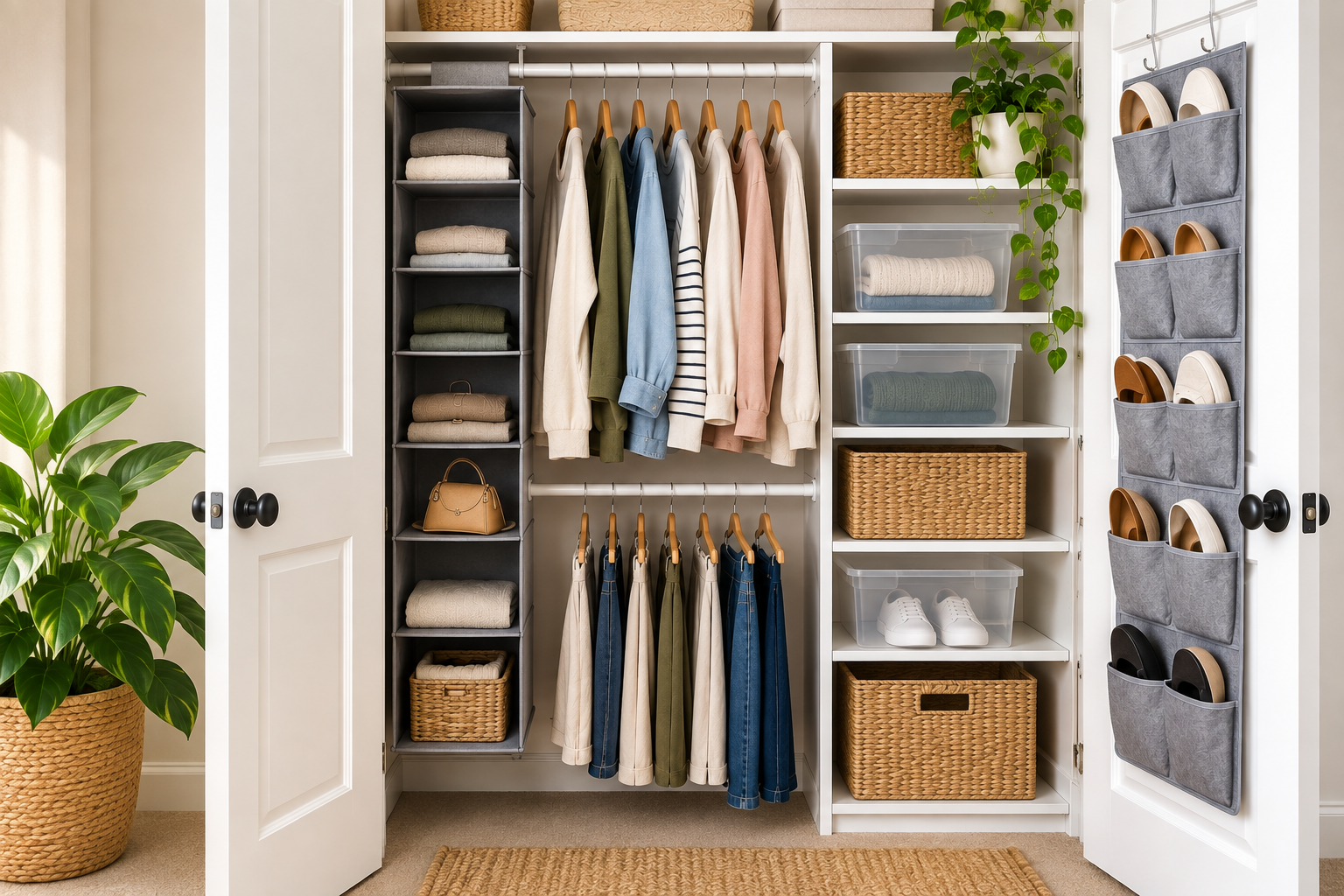
Creating more closet storage without drilling starts with using the structure that is already available. An existing rod, shelf, door, floor, and unused vertical space can often support a more efficient layout without permanent alterations.
Rental closets frequently have one shelf, one hanging rod, and limited floor area. The best way to improve that setup depends on the closet’s dimensions, existing fixtures, door movement, the weight of your belongings, and what you need to access most often.
Measure first, choose reversible additions that fit, and avoid loading any rod, door, shelf, or organizer beyond its stated limits.
Before Adding Closet Storage Without Drilling, Measure These Areas
Measuring prevents common problems such as drawers that cannot open, door hooks that hit the frame, and organizers that take up more hanging room than expected.
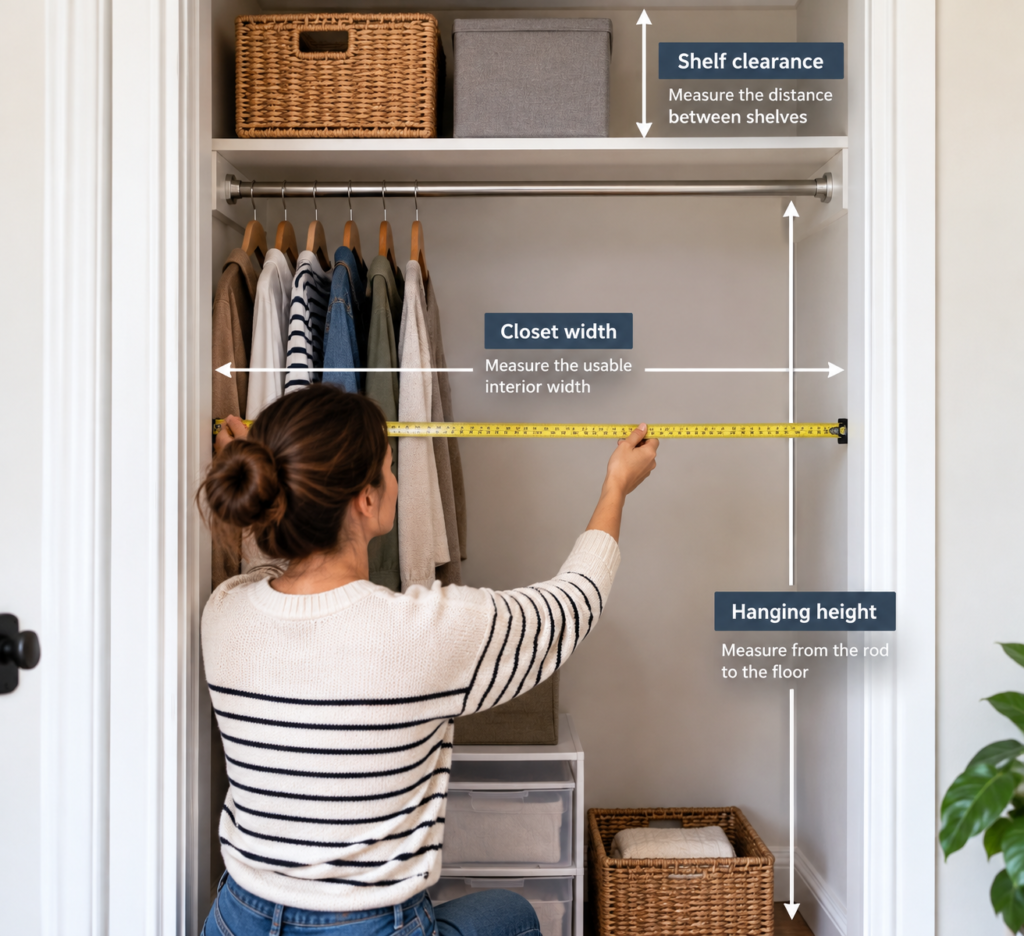
Empty enough of the closet to reach its edges and operate the doors normally. Then record:
 Save
Save- Closet width: Measure the usable interior width and note any trim or supports.
- Closet depth: Check whether organizers will interfere with clothing or door movement.
- Floor-to-shelf clearance: This helps determine whether a freestanding unit can fit.
- Hanging-rod height: Measure from the rod to the floor and to any shelf below it.
- Shelf depth: Include any lip, bracket, or support that affects usable space.
- Wall-to-clothing clearance: Leave room for garments to hang without being compressed.
- Door width and thickness: These affect over-the-door organizer fit.
- Door swing: Check the path of the door and anything stored behind it.
- Space above the rod: Note whether there is usable clearance beneath the shelf.
- Floor space below clothing: Measure separately beneath short and long garments.
- Sliding or bifold-door clearance: Make sure bins, racks, and handles stay out of the track and folding path.
Measure openings as well as interiors. An organizer may fit inside the closet but still be too large to pass through the doorway.
Renter warning: Measure first. A no-drill organizer can still damage a door, shelf, rod, or finish if it does not fit properly or is overloaded.
12 Renter-Friendly Closet Storage Ideas Without Drilling
 Save
Save1. Add a Hanging Closet Organizer
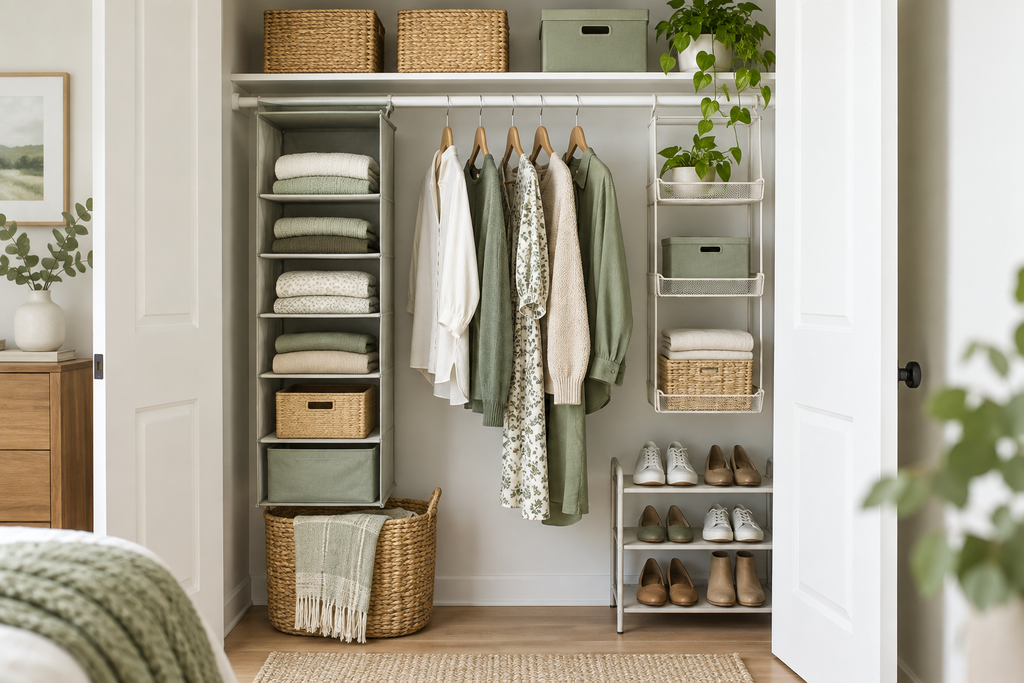
A hanging closet organizer suspends fabric or lightweight compartments from an existing closet rod. It can provide shelf-like storage for sweaters, folded clothes, bags, and accessories.
This works well when the closet has plenty of hanging height but too few shelves. Measure the organizer’s width and length so it does not cover needed clothing space or crowd items below it.
The organizer and its contents add weight to the rod. Confirm that the existing rod is secure enough for the intended load, and follow the organizer’s instructions.
2. Use a Double-Hang Closet Rod
A double-hang closet rod creates a second hanging level beneath the existing rod. It is useful for shirts, skirts, folded trousers, children’s clothing, and other shorter garments.
Measure the vertical space needed for both rows. Clothing on the upper level should not drag across the lower rod, and clothing below should clear the floor or any storage beneath it.
This arrangement is less suitable for long coats, dresses, or full-length garments. Check the condition of the original rod because it must support the added hardware and clothing.
3. Add Shelf Dividers to Existing Shelves
Closet shelf dividers separate folded clothing, towels, handbags, or linens so stacks do not spread into one another.
Clip-on dividers attach to a compatible shelf edge, while freestanding versions rely on their own base. Measure shelf thickness, depth, and overhead clearance before choosing a style.
Avoid forcing tight clamps onto delicate, painted, or laminated surfaces. Inspect contact points for rough edges or pressure that could mark the finish. Dividers organize existing shelf capacity but do not create additional weight capacity.
4. Use Stackable Bins or Drawers
Stackable closet storage bins and drawers can use closet floors or deep shelves more efficiently. They work well for accessories, seasonal clothing, small linens, and items that are difficult to keep upright.
Choose modules that fit the available width, depth, and height. Drawers need enough front clearance to open without hitting doors, clothing, or another organizer.
Keep labels simple and visible. Place heavier containers lower, avoid unstable stacks, and do not block vents, access panels, plumbing, or other service areas.
5. Add an Over-the-Door Closet Organizer
An over-the-door closet organizer can hold shoes, scarves, small bags, accessories, or suitable household supplies without occupying the closet floor.
Check the door’s thickness, top clearance, frame clearance, hinge condition, and swing. Hooks that are too thick can prevent the door from closing or rub against the frame.
The loaded organizer also adds stress to the door and hinges. Follow its instructions and keep the load appropriate. This method will not suit every sliding, bifold, hollow-core, closely fitted, or unusually shaped door.
6. Use the Space Below Hanging Clothes
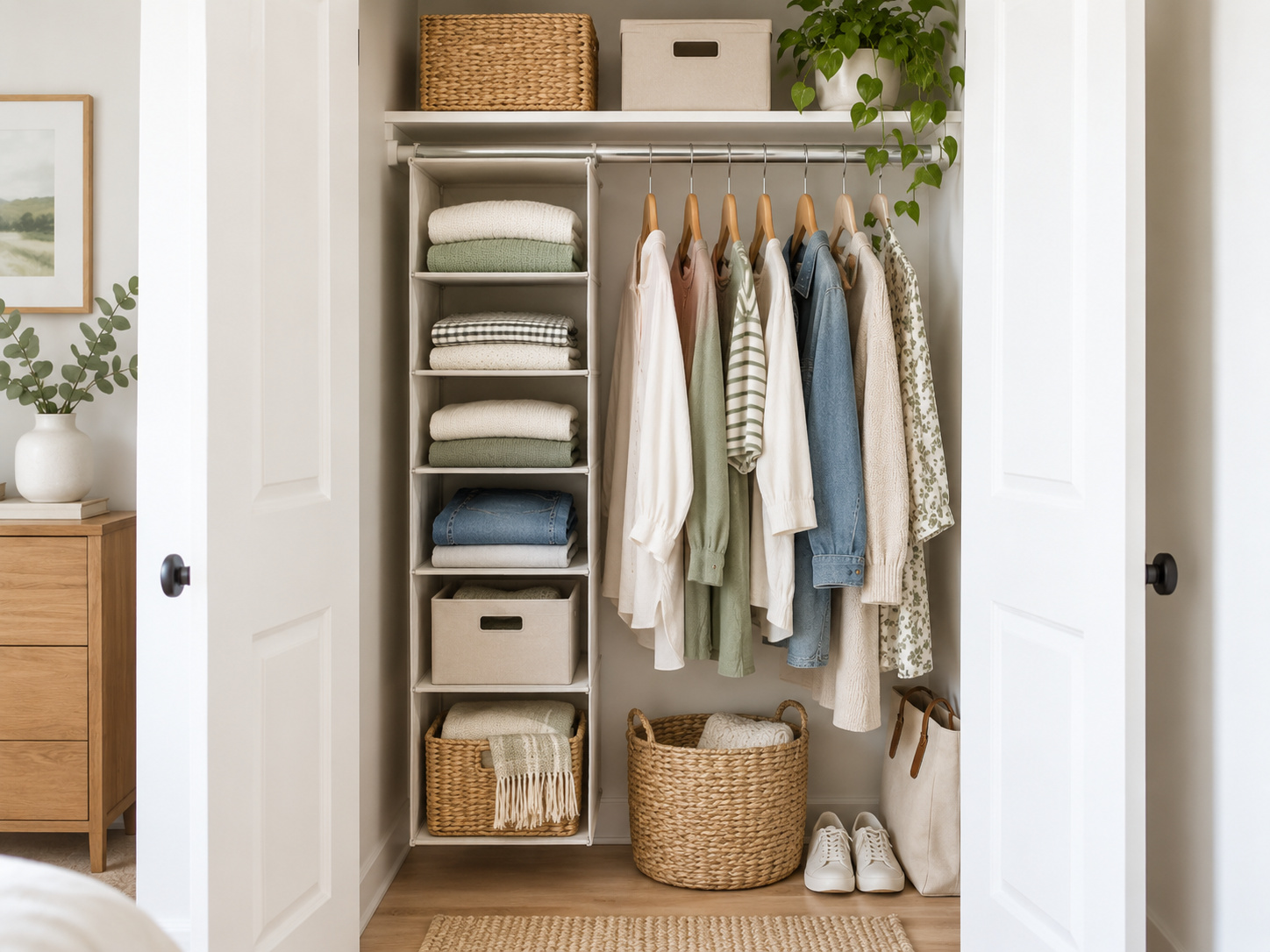
The floor beneath shirts and other short garments may hold low drawers, shoe racks, baskets, stackable bins, or a short shelf unit. For a fuller plan for this lower zone, see our guide to closet floor storage.
 Save
SaveSeparate short-hang and long-hang areas first. A low organizer that works beneath shirts may make coats or dresses bunch up, hide stored items, or collect dust from dragging fabric.
Measure the longest garments in each zone. Leave enough clearance to remove bins and open drawers without pushing clothing aside every time.
7. Add a Freestanding Closet Shelf Unit
A narrow freestanding closet shelf can create levels for shoes, folded clothes, bags, and bins without attaching to the wall.
Measure its full footprint and make sure it does not block doors, tracks, outlets, access points, or hanging clothing. Check whether the closet floor is level and whether the unit remains stable when loaded and used normally.
Avoid choosing a tall, narrow unit simply to maximize vertical storage. Stability depends on the unit, its proportions, the floor, loading, and the manufacturer’s instructions.
If the unit’s instructions require wall anchoring, do not treat it as a no-drill option unless that installation is permitted for your rental.
For general furniture tip-over safety, the U.S. Consumer Product Safety Commission recommends following manufacturer instructions and securing top-heavy furniture appropriately.
8. Use Tension Rods for Lightweight Storage
A tension rod fits between suitable opposing surfaces using pressure from its internal mechanism. Tension rod closet storage may provide a secondary point for lightweight accessories, hanging storage, or a simple divider.
Suitability depends on the span, contact surfaces, tension mechanism, installation, and product specifications. A rod intended for light accessories should not be assumed capable of supporting a row of heavy clothing.
Check for movement during use. If the rod slips, marks the surface, or requires excessive pressure to remain in place, choose another method.
9. Add Hanging Accessory Organizers
Compact organizers that hang from the existing rod can group belts, scarves, ties, hats, handbags, or jewelry pouches.
Moving these items off shelves and out of drawers can free useful space while keeping accessories visible. Group similar items so you can find them without unloading the organizer.
Position frequently used accessories within comfortable reach. Keep the organizer narrow enough that it does not crowd clothing, and account for its weight when evaluating the rod.
10. Use Slim or Matching Hangers
Hanger profile influences how much horizontal rod space a set of garments occupies. Using hangers with similar dimensions can make spacing more consistent and reduce tangling.
Suitability still depends on the clothing. Heavy coats, structured jackets, delicate fabrics, and garments that need shaped support may require different hangers.
Do not replace an appropriate garment-support hanger solely to make the closet look uniform. The goal is practical spacing without stretching, creasing, or damaging clothing.
11. Use Clear Bins for High Closet Shelves
For top shelf closet organization, clear bins can make seasonal accessories, spare linens, or infrequently used items easier to identify before you lift a container down.
Measure the shelf and opening so each bin can be lifted out without scraping the ceiling or frame. Labels can help when contents are not visible from below.
Keep overhead bins light and easy to control. Frequently used or heavy belongings are better stored at a more accessible height. Avoid stacks where removing one container destabilizes the others.
12. Create a Simple Closet Zone System
Zoning improves how existing storage is used without adding hardware.
Assign areas for everyday clothing, workwear, shoes, accessories, seasonal items, laundry, and rarely used belongings. Put frequently used categories where they are easiest to reach and reserve less convenient spaces for lighter, occasional items.
Zones do not need labels or matching containers. If one category repeatedly overflows, adjust its space before buying another organizer.
Which No-Drill Closet Storage Idea Is Best for Your Closet?
Use this comparison as a starting point. Exact compatibility and capacity depend on the closet and the organizer.
| Storage Method | Best For | Uses Existing | Main Limitation | What to Check |
|---|---|---|---|---|
| Hanging organizer | Folded clothes and bags | Closet rod | Reduces hanging width | Length, width, rod stability |
| Double-hang rod | Short garments | Closet rod | Limits long-hang space | Vertical clearance and rod strength |
| Shelf dividers | Folded stacks and bags | Existing shelf | Does not add shelf capacity | Shelf thickness and finish |
| Stackable bins | Accessories and seasonal items | Floor or shelf | Needs opening clearance | Width, depth, height, stability |
| Over-the-door organizer | Shoes and small accessories | Closet door | May affect closing or hinges | Door thickness, frame, swing |
| Freestanding shelf | Shoes, bins, folded clothes | Closet floor | Takes up floor area | Footprint, levelness, stability |
| Tension rod | Lightweight hanging storage | Opposing surfaces | Surface- and load-dependent | Span, contact points, rated use |
| Accessory organizer | Belts, scarves, and small bags | Closet rod | Adds rod weight | Visibility, width, rod condition |
How to Organize a Small Rental Closet Step by Step
- Remove items you no longer need in the closet.
- Group what remains by type.
- Measure the available spaces.
- Identify unused vertical, shelf, door, and floor space.
- Keep frequently used items easiest to reach.
- Choose one or two storage additions first.
- Install or position them according to their exact instructions.
- Load them gradually and keep within stated limits.
- Reassess after using the setup for a short period.
- Add more storage only if it solves a real remaining problem.
This staged approach makes it easier to see whether an organizer improves the closet or simply adds another obstacle.
Common Closet Storage Mistakes Renters Should Avoid
- Buying organizers before measuring
- Blocking sliding or bifold doors
- Overloading the existing closet rod
- Hanging too much weight from a closet door
- Stacking unstable containers too high
- Using tall freestanding units without considering stability
- Blocking access to electrical panels, vents, plumbing, or maintenance areas if present
- Assuming every tension rod can support clothing
- Storing very heavy items overhead
- Modifying rental shelving without permission
- Using adhesives or screws merely because another storage method does not fit
- Filling every available inch and making the closet difficult to use
An organized closet still needs room for doors, drawers, clothing, and people to move normally.
How to Keep a No-Drill Closet Setup Renter-Friendly
Keep original rods, shelves, brackets, doors, and other closet components in place unless the property owner has approved a change. Document preexisting marks or damage when relevant, follow lease restrictions, and use each organizer according to its instructions.
Protect delicate shelf and door finishes from sharp clamps, rough feet, and rubbing hardware. Avoid excessive loading, and periodically check rods, door hooks, tension systems, freestanding units, bins, and hanging organizers for movement or damage.
No storage method can guarantee protection from damage or a particular security-deposit outcome. Careful fit, appropriate loading, and reversible placement can reduce avoidable problems.
Frequently Asked Questions
How can I add closet storage without drilling?
Use existing rods, shelves, doors, floor space, and vertical clearance. Hanging organizers, double-hang rods, freestanding shelves, bins, shelf dividers, and compatible over-the-door storage can add capacity without drilling.
What is the easiest way to add shelves to a rental closet?
A hanging organizer or small freestanding shelf can provide shelf-like storage without altering the closet. Choose based on rod strength, floor space, fit, and stability.
Can I add a second closet rod without drilling?
A double-hang rod can suspend from an existing rod, and some tension systems fit between compatible surfaces. Check the product’s intended use, installation requirements, and load limit.
Do over-the-door organizers damage closet doors?
They can mark a door or frame, interfere with closing, or stress hinges if the fit or load is unsuitable. Measure the door and follow the organizer’s instructions.
Can tension rods be used for closet storage?
Some can, but capacity and compatibility vary. Consider the span, surfaces, mechanism, installation, and stated load. Do not assume a lightweight rod can support heavy clothing.
How can I organize a very small apartment closet?
Measure first, separate short- and long-hang areas, keep daily items accessible, and use one or two additions that address the biggest storage gaps.
What should I store on the top shelf of a closet?
A top shelf is generally better for lighter, infrequently used items that can be retrieved safely. Avoid heavy or unstable containers overhead.
How do I add more shoe storage without drilling?
Consider a low shoe rack, stackable bins, floor baskets, a suitable over-the-door organizer, or a compact freestanding shelf. Check door movement, garment clearance, and stability.
Can I use freestanding shelves inside a rental closet?
Yes, when the unit fits, remains stable, and does not block doors or service access. Follow its instructions, including any anchoring requirement.
Final Thoughts
Effective closet storage without drilling begins with accurate measurements and a clear understanding of what the closet needs to hold.
Use existing rods, shelves, doors, floor area, and vertical space only where the method fits and works with the closet’s normal operation. Check rod strength, door clearance, organizer stability, and product-specific limits before loading anything.
No-drill does not automatically mean risk-free. Start with a simple setup, use it for a while, and add more storage only when it solves a real problem.
If you are organizing other rental spaces too, our guide to bathroom storage without drilling covers additional reversible storage approaches for renters.