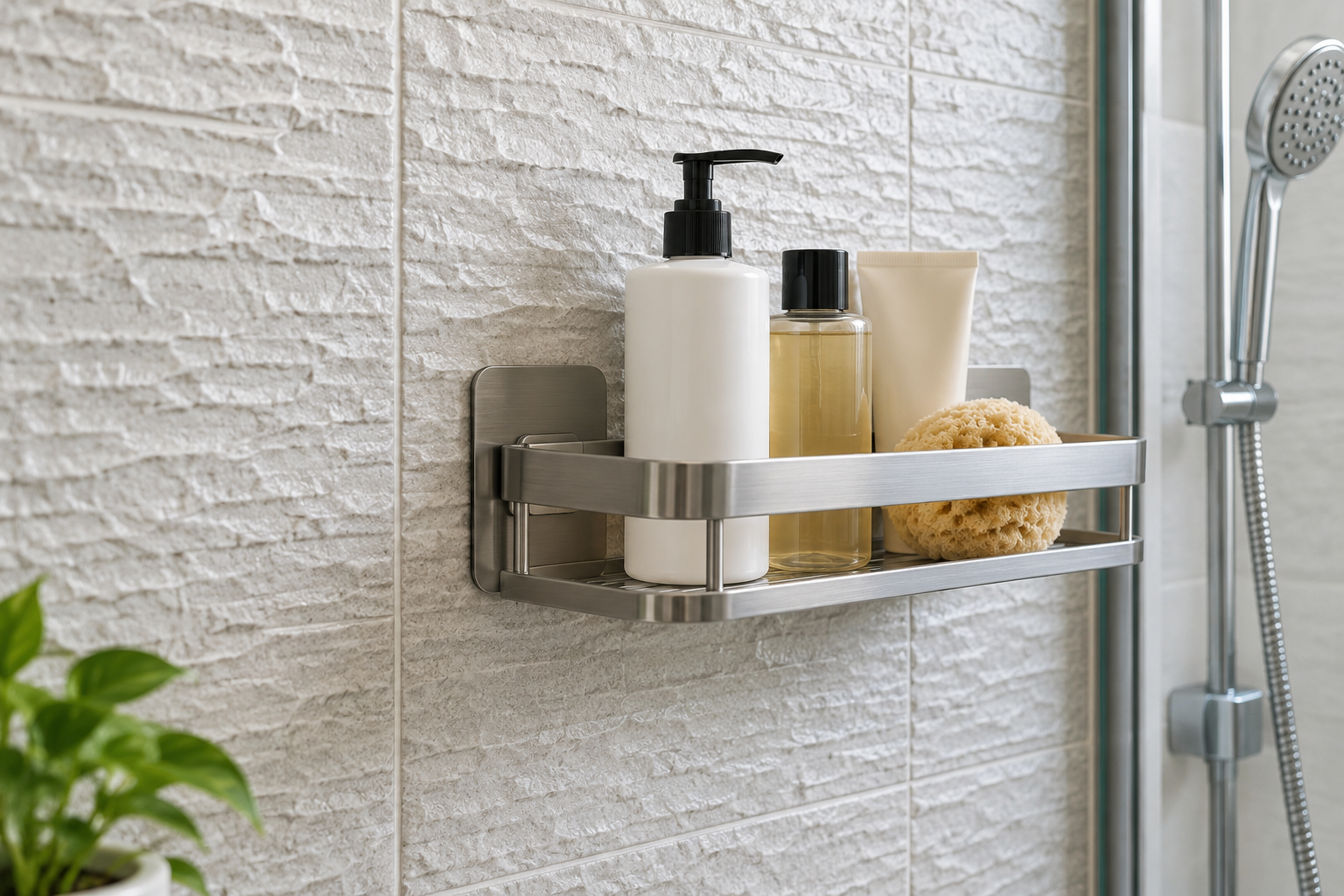
An adhesive shower shelf on textured tile may hold in some situations, but texture can make adhesion less reliable by preventing the mounting pad from contacting the wall evenly. The result depends on the depth and shape of the texture, tile material and finish, mounting-pad design, surface condition, moisture exposure, and the requirements of the exact shelf.
Light texture is different from deep grooves or a strongly embossed pattern. A soft, conformable pad may also interact with a surface differently from a rigid mounting plate.
For renters, the safest approach is to inspect the wall, dry-position the shelf, and read the official product instructions before exposing the adhesive. If the mounting surface or product documentation leaves room for doubt, use a storage method that does not depend on adhesion to the tile.
Do Adhesive Shower Shelves Stick to Textured Tile?
Sometimes, but there is no universal answer.
Adhesive mounting generally works best when the pad can make continuous contact with a compatible surface. Raised patterns and uneven areas can create gaps beneath the pad. Those gaps may reduce the effective mounting contact or allow edges to lift.
Shallow, regular texture may provide more usable contact than deep or irregular texture. Even so, appearance alone cannot establish compatibility. Different shelves use mounting plates and adhesives with different sizes, shapes, stiffness, and ability to conform to a surface.
The exact product instructions should determine whether a particular adhesive shelf is approved for your tile.
Why Tile Texture Matters for Adhesive Mounting
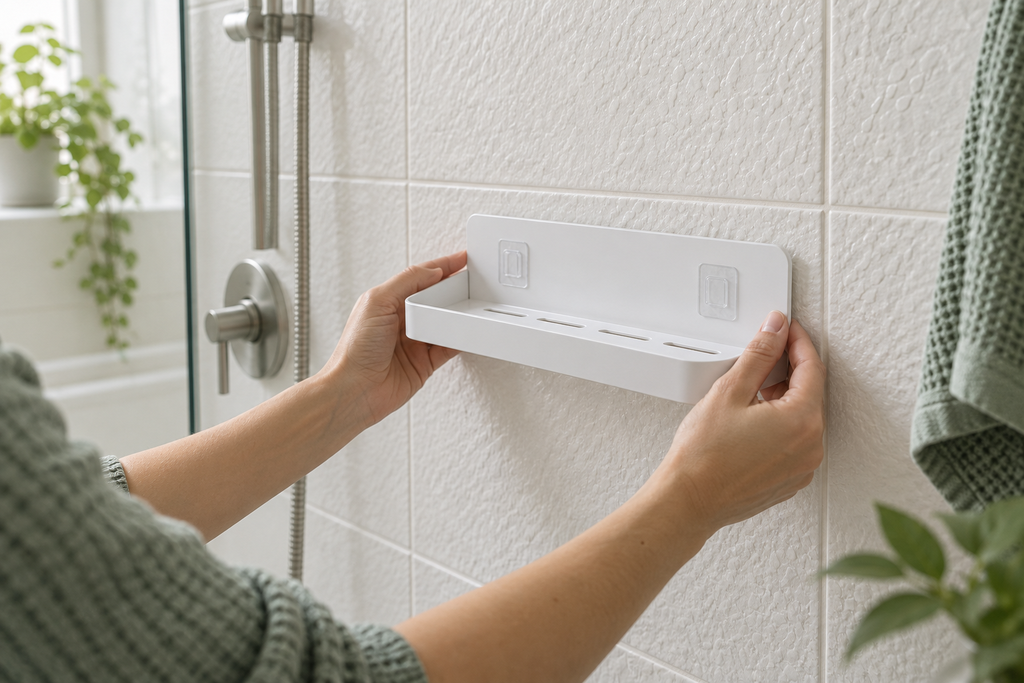
A textured tile surface contains peaks, valleys, ridges, or recesses. When an adhesive pad is pressed against it, the pad may touch the high points without fully reaching the low areas.
 Save
SaveThat distinction matters because apparent contact is not necessarily the same as real contact at the interface. General research on polymer adhesion and contact mechanics shows that surface roughness, material properties, deformation, and interfacial contact can affect adhesion. Roughness can reduce real contact when an adhesive cannot adequately conform to the surface, although the effect depends on the adhesive and substrate. Raos and Zappone, 2021; Ciavarella et al., 2019.
This is general adhesion science, not a performance test of consumer shower shelves. It does not prove that a particular shelf will succeed or fail on a particular tile.
For a shower organizer, the practical question is whether its complete mounting footprint can form the type of interface required by that specific system.
6 Things to Check Before Installing an Adhesive Shower Shelf on Textured Tile
1. How Deep Is the Tile Texture?
Look at the surface from the side and in good light.
A faint, uniform texture may leave fewer gaps beneath a mounting pad than deep grooves, raised patterns, embossed designs, or irregular stone-like finishes. However, there is no universal texture-depth cutoff that applies to every shelf.
Do not assume that a texture is minor simply because it is difficult to see from a distance. Inspect the entire mounting area closely and note whether the surface changes level within the pad’s footprint.
2. Can the Entire Mounting Pad Sit Flat?
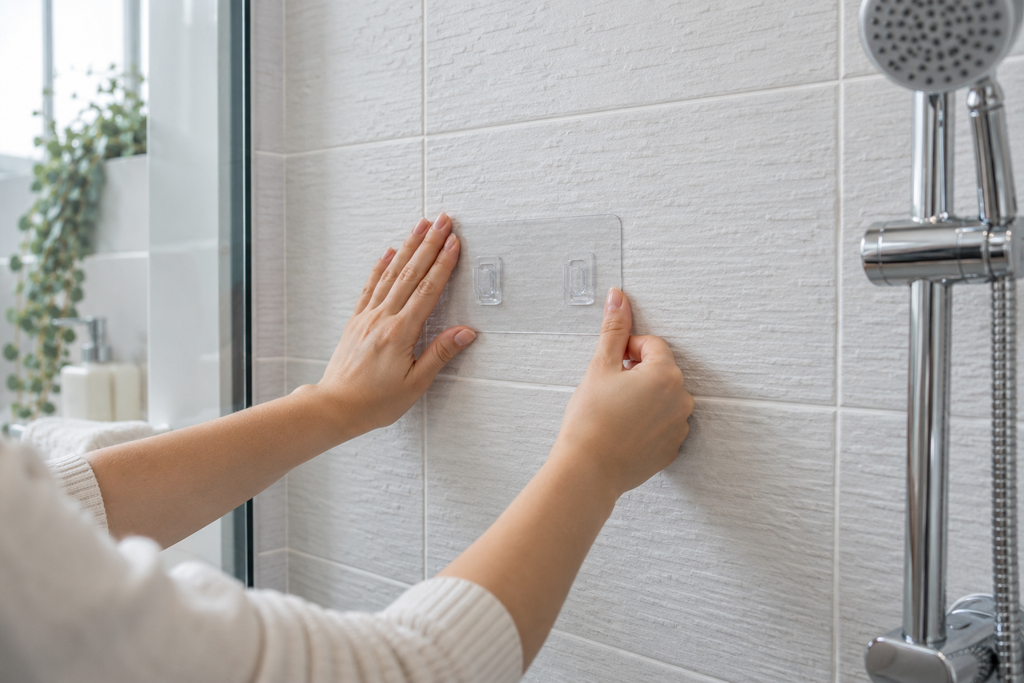
Hold the shelf, mounting plate, or unexposed template against the intended location. Do not remove the adhesive backing during this assessment.
 Save
SaveCheck the full footprint, not only its center. Look for visible gaps, rocking, edges that cannot sit down, or parts of a rigid plate bridging raised areas.
A flexible pad may conform differently from a rigid plate, but flexibility does not guarantee compatibility. If the mount cannot sit as the instructions require, choose another location or storage method.
3. Does the Mounting Area Cross Grout Lines?
A recessed grout joint introduces another change in level. When texture and grout occur beneath the same pad, both can interrupt continuous mounting contact.
Avoid assuming that a large pad can simply bridge the joint. Consult the exact product instructions.
For a closer look at this specific issue, see adhesive shower shelf over grout lines.
4. Is the Tile Surface Clean and Free of Residue?
Soap film, body-care products, oils, mineral deposits, cleaner residue, and surface coatings can interfere with bonding.
Contamination matters at adhesive interfaces, but its effect varies with the materials and system involved. Research on engineered adhesive joints supports treating surface condition, moisture, and contamination as relevant interfacial factors; it does not establish one universal cleaning process for consumer bathroom shelves. Borges et al., 2021.
Use the cleaning method specified by the shelf manufacturer while also following the tile maker’s surface-care guidance. Do not substitute a universal cleaner based on general advice.
5. Is Moisture Likely to Reach the Adhesive?
Consider direct shower spray, condensation, a wet installation surface, and water reaching the mounting edges.
Moisture does not automatically make every adhesive fail. Bathroom-rated systems may be designed for wet environments, while other adhesives may not be suitable inside a shower.
Install only under the conditions stated for the exact product. If the surface must be dry or the mount must remain unloaded for a stated period, follow those instructions precisely.
6. Does the Exact Shelf Approve That Surface?
This is the deciding check.
Read the official installation instructions and look for:
- Approved surface types
- Prohibited or unsuitable surfaces
- Texture or grout restrictions
- Required surface preparation
- Mounting-pad positioning
- Waiting requirements
- Load limits
- Removal instructions
Use official manufacturer documentation for the exact shelf or mounting system—not a retailer description or guidance for a different product.
If textured tile is excluded or not clearly covered, do not infer approval from a general “bathroom,” “removable,” or “no-drill” label.
How to Check Textured Tile Before Installation
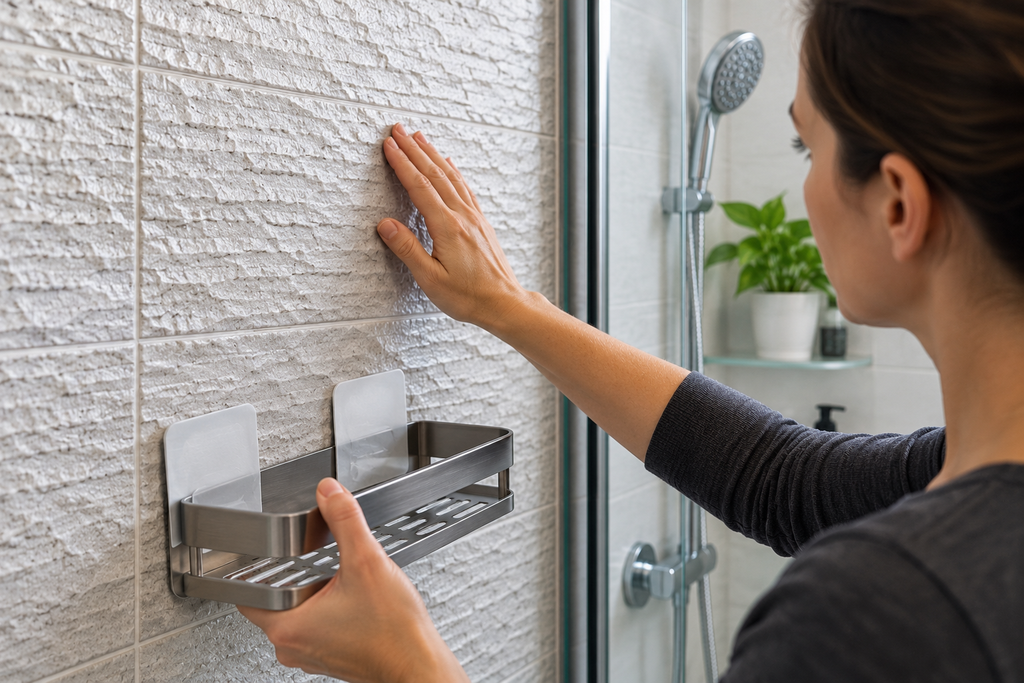
Use this pre-installation assessment:
 Save
Save- Identify the tile material and finish.
- Look at the mounting location in good light.
- Check for ridges, recesses, patterns, and grout joints.
- Compare the mounting-pad footprint with the usable flat area.
- Hold the shelf or template in position without exposing the adhesive.
- Look for visible gaps beneath the mounting area.
- Check the exact manufacturer’s approved-surface guidance.
- Confirm preparation and waiting requirements for the exact product.
- Choose another mounting location or storage method if compatibility is uncertain.
Do not perform an improvised adhesion test that could mark the finish. A rental wall is not the place to experiment with unrelated tapes, glues, or solvents.
Which Types of Textured Tile Are More Difficult for Adhesive Shelves?
Lightly textured glazed tile. A shallow texture may allow more pad contact than a deeply patterned surface, but the glaze, texture, and mounting system must still be compatible.
Deeply embossed tile. Raised designs can prevent a flat mounting plate from contacting the recessed portions of the tile.
Stone-look textured tile. These tiles may imitate irregular stone topography even when made from ceramic or porcelain. Judge the actual surface, not the visual label alone.
Mosaic tile. Numerous small pieces create frequent grout joints, leaving less uninterrupted space for a mounting pad.
Small tiles with frequent grout joints. Even relatively smooth tiles may be difficult to use when the mount cannot fit within one tile face.
Matte or specialty-coated tile. Matte appearance does not automatically mean the tile is unsuitable. Its texture, coating, care requirements, and the adhesive manufacturer’s restrictions all matter.
Natural stone. Porosity, sealers, surface variation, and care requirements create concerns beyond texture. Do not treat natural stone like ordinary glazed tile or apply adhesive without explicit compatibility guidance.
What If the Tile Is Only Slightly Textured?
Light texture may permit more contact than deep grooves or a strongly embossed finish, but it is not automatically safe or suitable.
A pad’s size, stiffness, thickness, and ability to conform can affect how it meets the tile. Visual inspection can reveal obvious gaps, but it cannot confirm adhesive chemistry or long-term performance in a wet bathroom.
Follow the exact product documentation. If it requires a smooth, flat surface and your tile is visibly textured, do not reinterpret that requirement based on the texture seeming minor.
What If the Adhesive Shelf Has Already Fallen?
Empty the shelf and inspect the mount, adhesive components, tile, and grout.
Possible contributors include incompatible texture, incomplete pad contact, contamination, moisture, grout interference, loading before the specified time, excessive weight, uneven loading, or damaged mounting components.
Do not automatically reapply the same component. Follow the manufacturer’s replacement and reinstallation instructions.
For a fuller troubleshooting process, see adhesive shower shelf keeps falling.
Should You Use Suction Instead on Textured Tile?
Suction is not an automatic solution.
Many suction systems need a smooth, flat, nonporous surface to form and maintain a seal. Texture may leave channels through which air can enter, preventing reliable suction.
Check the exact suction product’s approved surfaces before switching. For a broader comparison, see adhesive vs suction shower shelves.
Renter-Friendly Alternatives for Textured Shower Walls
If the wall is unsuitable, choose storage that does not depend on adhesive contact with the textured tile.
Options include:
- A tension shower caddy compatible with the room’s height and surfaces
- A shower-head caddy that fits without interfering with controls or plumbing
- An over-the-door organizer where the door and clearance are suitable
- A freestanding bathroom cart outside the wettest area
- Storage placed outside the shower but within convenient reach
For more options, see bathroom storage without drilling.
Renter warning: Do not modify, sand, grind, or permanently alter rental bathroom tile simply to make an adhesive mounting system fit.
What Not to Do on Textured Tile
- Do not assume all bathroom-rated adhesive works on textured tile.
- Do not add random household glue or construction adhesive.
- Do not fill texture with unrelated tape or adhesive.
- Do not sand, grind, or alter rental tile.
- Do not install across damaged grout.
- Do not ignore visible gaps beneath the mounting pad.
- Do not shorten any manufacturer-specified waiting period.
- Do not exceed the stated load limit.
- Do not keep reinstalling a shelf that repeatedly detaches.
- Do not treat a no-drill product as automatically damage-free.
When Should You Choose Another Storage Method?
Choose another method when the texture is deep, the mounting plate cannot sit flat, or the surface falls outside the product’s approved compatibility.
Frequent grout joints, cracked tile, unstable grout, persistent moisture at the mounting area, or repeated detachment also indicate that the location or system may be unsuitable.
Lease restrictions and specialty finishes deserve additional caution. If you cannot confirm that the mounting and removal process is appropriate, a tension-based, hanging, or freestanding organizer is usually the more practical choice.
The goal is useful storage—not forcing one mounting method to work on an incompatible wall.
Frequently Asked Questions
Can adhesive shower shelves stick to textured tile?
They may stick to some lightly textured surfaces, but performance depends on the texture, material, finish, mounting-pad design, surface condition, and product requirements. Do not assume universal compatibility.
Why does adhesive not stick well to rough tile?
A mounting pad may touch raised areas while leaving gaps over lower areas. That can reduce continuous contact at the adhesive interface. Exact behavior depends on the adhesive and substrate.
Can I use an adhesive shelf on lightly textured tile?
Only if the exact shelf instructions approve the surface and the mount can be installed as required. Light texture may allow more contact than deep texture, but it does not guarantee suitability or damage-free removal.
Can adhesive strips bridge tile texture?
Some pads may conform more than others, but a strip should not be assumed to bridge ridges, grooves, or recesses successfully. Follow the mounting system’s official surface guidance.
Can I install an adhesive shower shelf across grout lines?
A grout line may interrupt the mounting surface, especially when it is recessed or uneven. Check the exact instructions rather than assuming the pad can bridge it.
Will cleaning textured tile help adhesive stick?
Cleaning can remove contamination that might interfere with bonding, but it cannot make an incompatible texture flat. Use only the preparation method required by the mounting-system instructions and compatible with the tile.
Do suction shower shelves work better on textured tile?
Not necessarily. Texture may prevent a suction cup from forming the continuous seal it needs. Suction compatibility must also be checked product by product.
What should I use instead of adhesive storage on textured shower walls?
Consider a compatible tension caddy, shower-head caddy, over-the-door organizer, or freestanding storage outside the direct shower area.
Final Thoughts
Texture can reduce the mounting contact available to an adhesive pad, and deeper or more irregular surfaces may be more challenging than shallow, uniform texture. Grout, contamination, moisture, tile characteristics, mounting design, installation, and loading also matter.
General adhesion research helps explain why surface topography and interface condition deserve attention, but it cannot predict the performance of a specific consumer shelf.
Before installing an adhesive shower shelf on textured tile, inspect the complete mounting footprint and defer to the exact product documentation. If compatibility is uncertain or the shelf repeatedly detaches, do not force the mounting method. Renter-friendly alternatives can provide useful storage without altering the tile.