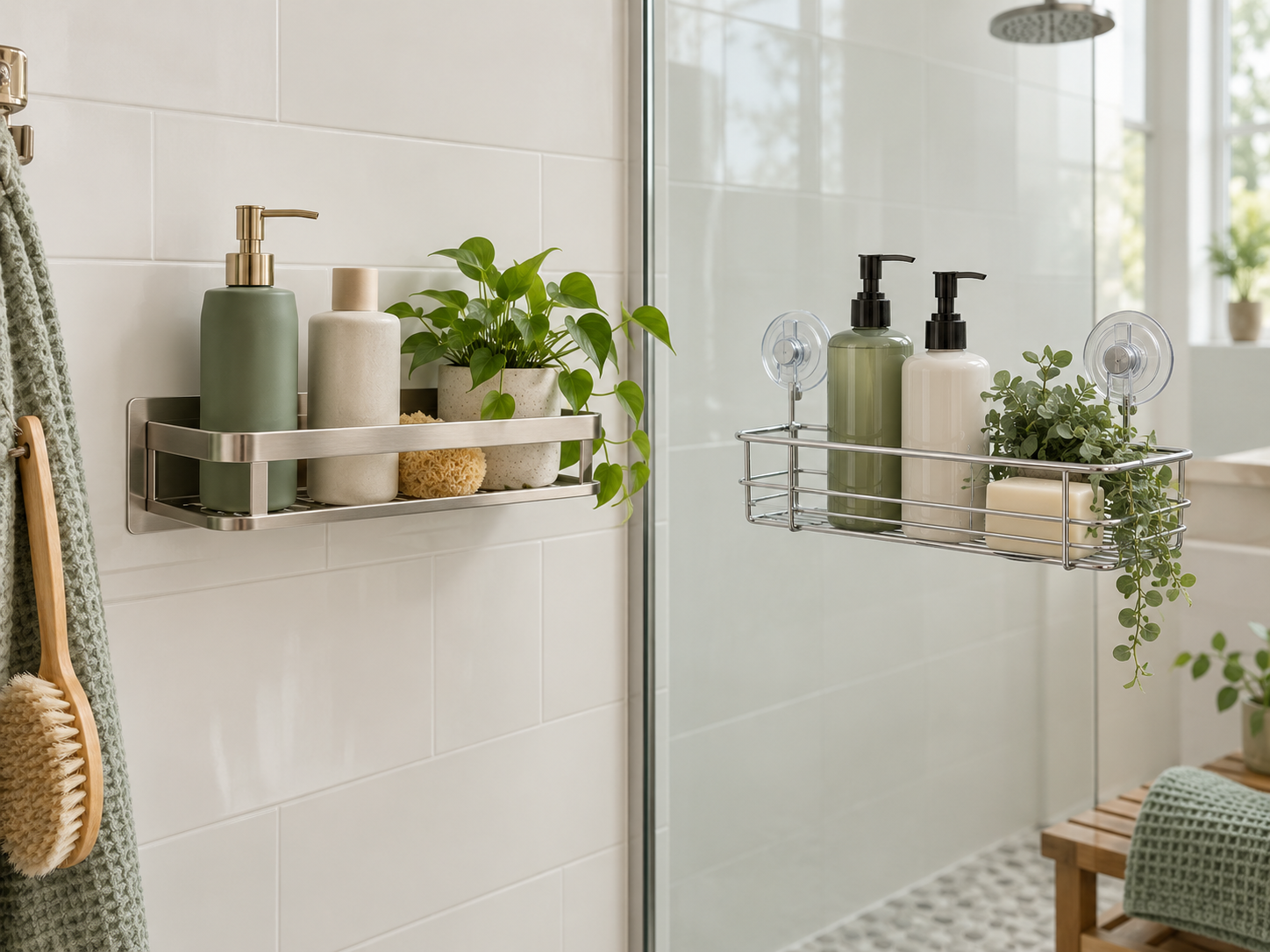
A shower shelf can make a small bathroom easier to use without taking up floor space. For renters, however, choosing a mounting method involves more than finding a shelf that fits.
Adhesive shelves attach with strips, pads, or mounting plates designed to bond to the wall. Suction shelves rely on a seal between the suction cup and a smooth surface. Both avoid drilling, but neither method is universally suitable or guaranteed to be damage-free.
The better choice depends on the shower surface, its texture and condition, how carefully it is cleaned, the amount of moisture in the area, the shelf’s design, the intended load, and the manufacturer’s installation and removal instructions.
If your adhesive shower shelf keeps falling, check the mounting surface, residue, moisture, grout placement, contact area, load, and condition of the adhesive system before reinstalling it.
If your suction cup shower shelf keeps falling, check the mounting surface, grout lines, cleanliness, seal, load, and condition of the suction cups before reinstalling it.
If an adhesive shower shelf keeps falling after installation, the cause may involve surface preparation, moisture, incomplete mounting contact, loading, or the condition of the adhesive components.
If you are considering an adhesive shower shelf on textured tile, check whether the mounting pad can sit flat and whether the exact product approves that surface before installation.
This adhesive vs suction shower shelves comparison explains those tradeoffs so you can choose a practical option for your rental bathroom.
Adhesive vs Suction Shower Shelves at a Glance
| Factor | Adhesive shower shelf | Suction-cup shower shelf |
|---|---|---|
| Mounting method | Uses adhesive strips, pads, or mounting plates that bond to the wall | Uses suction cups that create a seal against the wall |
| Suitable surfaces | Usually smooth, clean surfaces approved by the product manufacturer | Usually smooth, flat, nonporous surfaces such as glass or certain glazed tiles |
| Moisture considerations | Requires a product intended for bathroom use and careful surface preparation | The seal can weaken if the surface or cup is dirty, textured, damaged, or unable to maintain suction |
| Holding strength/load | Varies by adhesive system, shelf design, installation, surface, and rated limit | Varies by suction mechanism, cup size, surface, installation, and rated limit |
| Removal | May require a specific pulling, stretching, warming, or release procedure | Usually removed by releasing a tab, lever, edge, or vacuum seal |
| Reusability | Adhesive components often need replacement after removal | Frequently repositionable if the cups remain clean and undamaged |
| Potential damage concerns | Adhesive may leave residue or affect some finishes | A falling shelf can damage items or surfaces; cups may leave temporary marks |
| Best use case | Compatible surface where a more fixed position is preferred | Very smooth compatible surface where repositioning is useful |
This table provides general guidance. Instructions and compatible surfaces vary among manufacturers and products. Always check the documentation for the specific shelf before installing it.
How Adhesive Shower Shelves Work
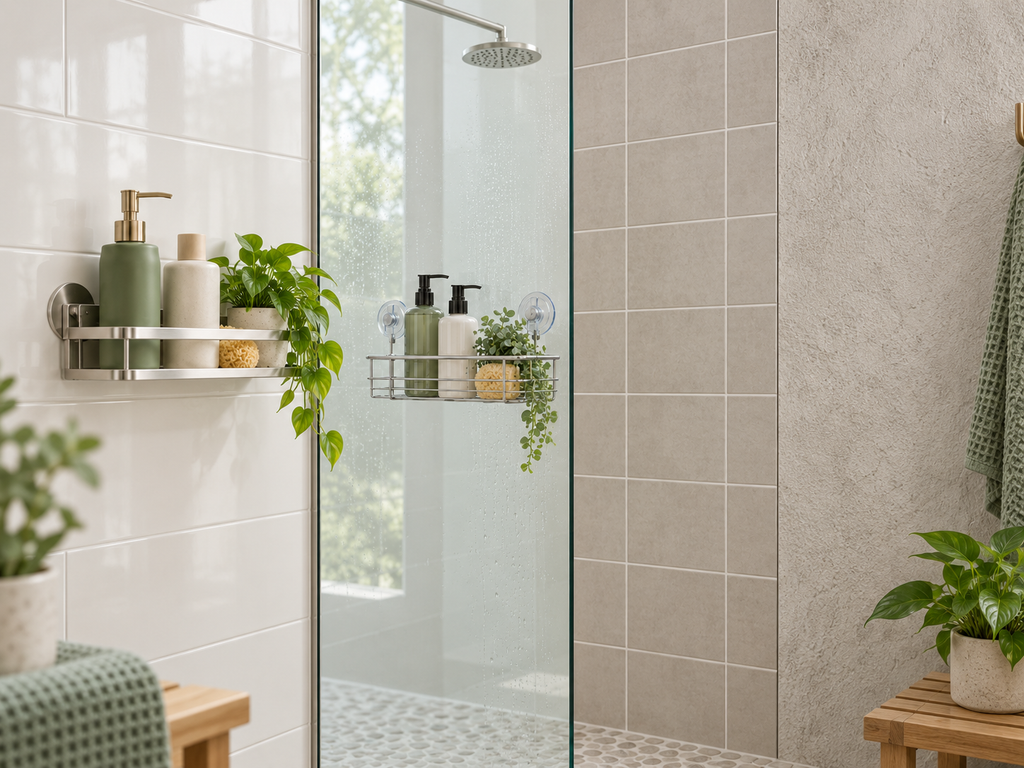
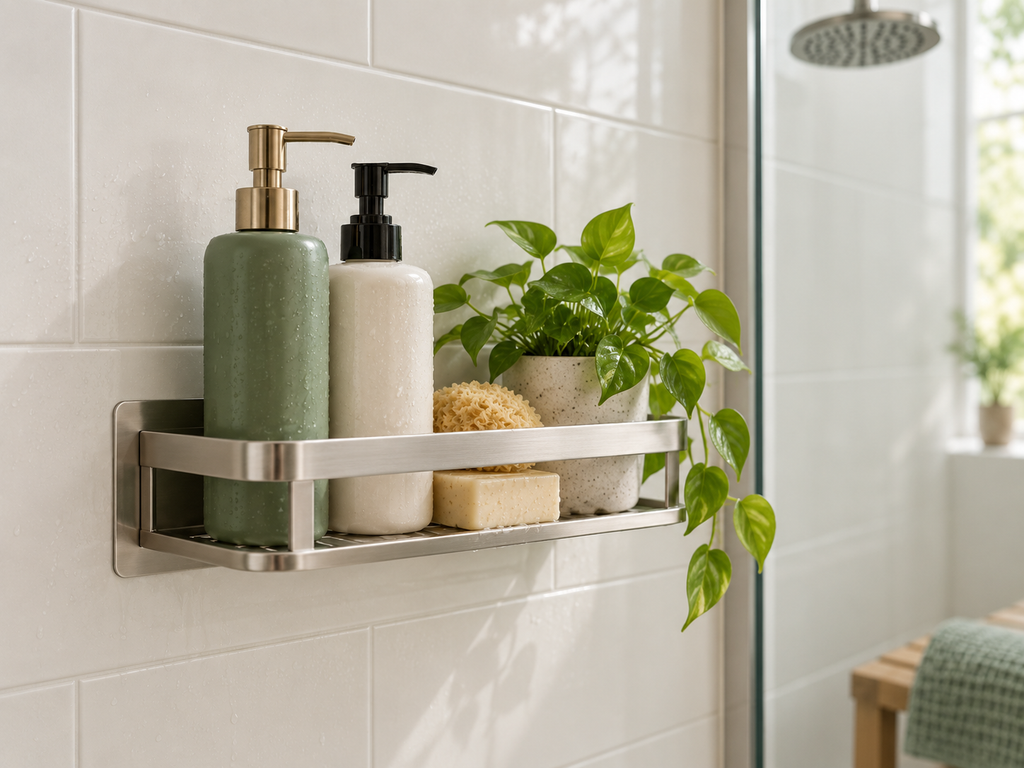
An adhesive shower shelf typically uses bonding strips, pads, or mounting plates between the shelf and the wall. Some shelves attach directly to those components, while others slide onto a base after the adhesive has been applied.
Successful installation depends on the adhesive making consistent contact with a compatible surface. Dust, soap residue, mineral deposits, moisture, texture, and damaged finishes can interfere with that contact.
Bathroom-specific adhesives may be designed to tolerate moisture better than ordinary household adhesive products. That does not mean every adhesive shelf is suitable for use inside a shower. Look for explicit manufacturer guidance about wet-area use.
Many systems also require a particular cleaning method, firm pressure during installation, and a waiting period before the shelf is loaded. Those details are product-specific and should not be guessed or replaced with general advice. Command Bathroom Solutions provides an example of manufacturer-specific application and removal guidance.
An adhesive shower shelf for renters may feel more stable than a basic suction design, but removal deserves equal attention. A product described as removable can still cause problems if it is installed on an incompatible finish or removed incorrectly.
 Save
SaveHow Suction-Cup Shower Shelves Work
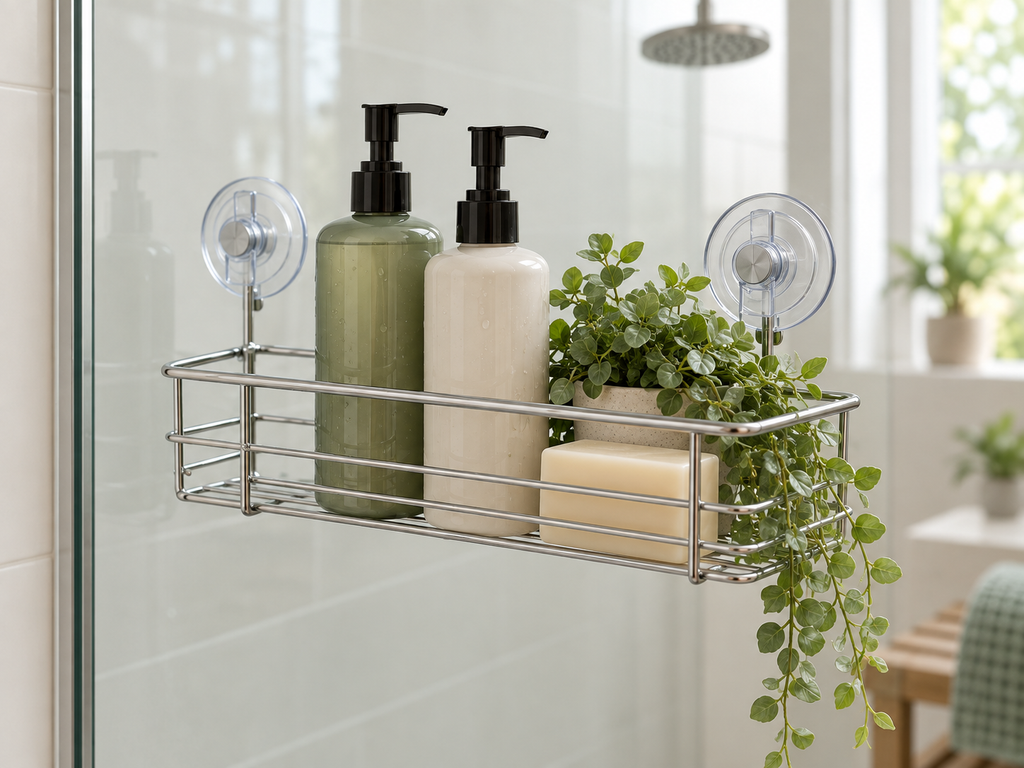
A suction cup works by pressing flexible material against a surface and pushing air out from underneath it. The resulting pressure difference helps hold the cup in place.
That seal requires the right surface. A suction cup shower shelf generally works best on smooth, flat, nonporous materials. Glass and some glazed tiles are common examples, but not every tile is suitable.
Texture, grout lines, cracks, curved surfaces, porous stone, and uneven joints can prevent a complete seal. Even a tile that appears smooth from a distance may have a fine texture that reduces suction.
Some products use a simple press-on cup. Others add a lever, twist lock, or pump-style mechanism. Their installation and maintenance requirements are not interchangeable.
Suction also does not mean maintenance-free. The cup and wall may need periodic cleaning, inspection, or reattachment according to the manufacturer’s directions. Refer to informational guidance such as OXO StrongHold suction guidance and IKEA TISKEN suction guidance for examples of product-specific surface recommendations.
 Save
SaveWhich Surfaces Work Best for Each Type
Surface compatibility should be the first decision point—not whether adhesive or suction sounds stronger.
Suction shelves are usually most promising on smooth glass or large, flat glazed tiles. The entire cup must sit on one continuous surface. A cup positioned partly over grout is unlikely to form the seal it needs.
Adhesive systems may also require smooth surfaces and can have restrictions for grout, rough tile, wallpaper, painted walls, porous materials, or delicate coatings. Bathroom-specific adhesive products can differ substantially, so consult the approved-surface list for the exact model.
If your mounting area includes grout joints, our guide to using an adhesive shower shelf over grout lines explains what to check before installation, including grout depth, condition, surface contact, and mounting footprint.
If you are considering an adhesive shower shelf on textured tile, check whether the mounting pad can sit flat and whether the exact product approves that surface before installation.
Inspect the wall before installation. Look for:
- Texture you can feel with your fingertips
- Grout where the mount would sit
- Cracks, chips, or loose material
- Peeling paint or coatings
- Soap film, mildew, or mineral buildup
- Existing residue from an earlier organizer
Do not use a mounting product as a way to cover a damaged area. In a rental, photograph preexisting wall damage and report maintenance concerns when appropriate.
 Save
SaveAdhesive vs Suction Shower Shelves for Renters
Surface Compatibility
Suction offers a narrower but relatively clear starting point: smooth, flat, nonporous surfaces. If your shower has textured tile or small tiles with closely spaced grout lines, finding a suitable location may be difficult.
Adhesive compatibility depends heavily on the adhesive system. Some products are intended for particular tile, glass, or bathroom surfaces, while others should not be used in consistently wet areas.
A “no-drill” label does not establish compatibility. Read the surface guidance before purchasing or opening the mounting components.
Holding Strength
There is no reliable rule that every adhesive shelf holds more than every suction shelf, or vice versa.
Holding performance depends on the product’s design, the quality of the installation, surface conditions, moisture exposure, weight distribution, and the rated load. A well-designed suction mechanism on compatible glass may outperform a poorly installed adhesive shelf. A suitable bathroom adhesive may be more consistent than a basic suction cup on marginal tile.
Never exceed the manufacturer’s load limit. Remember that the shelf must support the containers as well as their contents.
Bathroom Moisture
Showers expose organizers to humidity, water, soap residue, and temperature changes.
Adhesive products need to be approved for the intended bathroom location. An adhesive suitable near a sink may not be designed for direct shower spray.
Suction cups need a clean contact area to maintain their seal. Residue can collect around or beneath the cup over time, depending on the design.
Position either type away from unnecessary direct spray when the layout and instructions allow. Drainage also matters: water should not remain trapped in the shelf.
Installation
Both systems can be tool-free, but that does not make preparation optional.
Installation may involve cleaning the wall with a specified substance, drying it completely, applying pressure for a set period, waiting before loading, or activating a locking mechanism.
Follow the product’s instructions rather than combining tips from unrelated mounting systems. A cleaner recommended for one adhesive could leave residue that is unhelpful for another product.
Plan the position before installation. Confirm that bottles fit, the shelf does not interfere with shower controls, and users will not bump it while entering or turning.
Removal
Adhesive removal often requires a specific direction and technique. Some systems use a stretch-release tab; others have different instructions. Pulling a mount straight away from the wall when the directions say to stretch it along the surface can increase the risk of damage.
A suction shelf is usually released by breaking the seal, lifting an edge, or operating a lever. Do not pry aggressively with a sharp tool that could scratch the wall.
In either case, support the empty shelf during removal. Do not rely on the mounting point to hold it while you force the release.
If you already have an adhesive shelf installed, see our guide on how to remove an adhesive shower shelf carefully and reduce the risk of damaging bathroom tile.
Reusability
Suction shelves are often easier to reposition because they do not depend on a single-use adhesive strip. Their reusability still depends on the cup remaining clean, flexible, and undamaged.
Adhesive shelves may have reusable hardware but require new mounting strips or pads. Use only replacement components approved for that system.
Do not reuse an adhesive component simply because it still feels sticky. Its holding ability may no longer match its original rating.
Cleaning
A shelf should be easy to empty and clean without disturbing the mount unnecessarily.
Soap film and mineral buildup can affect the wall, shelf, and mounting area. Removable trays or baskets may simplify cleaning, but design varies.
For suction products, inspect the cups and the surface as directed. For adhesive products, avoid saturating or scrubbing the mount unless the manufacturer says that is acceptable.
Keep drainage openings clear and check for corrosion, cracks, looseness, or other signs that the organizer should be removed.
Damage Risk
Neither option is automatically damage-free.
Adhesive can leave residue or lift weak paint, coatings, wallpaper, or damaged surface material. Incorrect removal can increase that risk.
Suction avoids adhesive residue, but a shelf that releases unexpectedly can fall, spill products, chip belongings, or mark the tub or shower floor. Some suction products are also unsuitable for particular finishes.
Renters should consider both wall damage and the consequences of mounting failure.
When an Adhesive Shower Shelf Makes More Sense
An adhesive shelf may make more sense when:
- The manufacturer approves your shower surface and wet-area location
- The mounting area is smooth, intact, and large enough
- You want the shelf to remain in one consistent position
- The installation and removal procedures are practical for your rental
- The expected load stays comfortably within the stated limit
- Suction cannot form a dependable seal on the available surface
Before installing, consider whether you have permission to apply the product. Lease language and property policies vary.
For broader ideas that do not require drilling, see bathroom storage without drilling.
When a Suction Shower Shelf Makes More Sense
A suction shelf may be the better fit when:
- You have smooth glass or compatible flat, glazed tile
- Each suction cup can avoid grout lines and texture
- You want to reposition or remove the shelf more easily
- You are willing to inspect and reattach it as directed
- You need storage for a modest, predictable load
- You prefer not to place adhesive on the shower surface
Test the placement while the shelf is empty. After installation, load it gradually without exceeding the stated limit.
If a cup repeatedly loses its seal, do not compensate by continually adding pressure while leaving breakable or heavy items on the shelf. Reassess the surface and product compatibility.
When Neither Option Is a Good Choice
Neither adhesive nor suction is a good choice when the available surface is rough, porous, cracked, loose, heavily textured, or specifically excluded by the manufacturer.
They may also be unsuitable when:
- Grout lines prevent the mounts from sitting flat
- The shelf would interfere with plumbing fixtures or shower controls
- Falling items could create a meaningful injury or damage risk
- The wall has wallpaper, peeling paint, or an uncertain coating
- The organizer would need to hold more than its rated limit
- Property rules prohibit the proposed mounting method
- You cannot follow the required installation or removal procedure
Alternatives include a tension shower caddy, freestanding storage outside the wettest area, or an organizer that hangs from a suitable shower fixture without obstructing its operation.
Over-door solutions may also work outside the shower when the door, hinges, frame, and clearances are appropriate. Review over-the-door bathroom storage before choosing one.
How to Reduce the Risk of Damage or Falling Shelves
A few precautions can make either option more renter-conscious:
- Read the exact instructions first. Confirm approved surfaces, bathroom suitability, preparation, curing time, load limit, maintenance, and removal steps.
- Inspect the surface. Do not mount over loose material, cracks, grout, or damage unless the manufacturer explicitly approves that condition.
- Clean as directed. Soap film and residue can interfere with mounting. Use the cleaning method specified for the product rather than assuming any household cleaner will work.
- Let the surface dry when required. Moisture beneath a mount can compromise installation.
- Choose the position carefully. Keep the shelf away from controls, door movement, and places where someone may lean on or bump it.
- Start with an empty shelf. Confirm that the mount is secure before adding products.
- Load gradually and evenly. Keep the total below the manufacturer’s stated limit and avoid placing heavy containers on one side.
- Do not treat it as a grab bar. A storage shelf is not designed to support a person unless it is explicitly certified for that purpose.
- Check it regularly. Look for movement, gaps, residue, deformation, or loosening. Remove the contents if anything changes.
- Remove it exactly as directed. Rushing or improvising can damage the surface, the mount, or both.
- Document the rental surface. Photograph its condition before installation, especially if it already has chips or marks.
- Have a fallback plan. If the shelf falls or begins to loosen, switch to freestanding or tension-based storage instead of repeatedly reinstalling an unsuitable mount.
Frequently Asked Questions
Do adhesive shower shelves damage tile?
They can, depending on the tile, coating, grout, adhesive, installation, and removal method. Smooth, intact tile approved by the manufacturer may present less risk than a loose, textured, coated, or damaged surface, but damage-free removal is never guaranteed. Follow the exact removal procedure and avoid placing adhesive over grout unless explicitly permitted.
Do suction cups work on shower tile?
They can work on some smooth, flat, nonporous glazed tiles. They may not seal on textured, porous, cracked, curved, or very small tiles, or across grout lines. Check the suction product’s approved surfaces rather than assuming all shower tile is compatible.
Which holds more weight: adhesive or suction?
Neither mounting method is universally stronger. Capacity depends on the individual shelf, mounting components, surface, installation, moisture exposure, load distribution, and product design. Compare manufacturer-rated limits for products suitable for your surface, and never exceed those limits.
Can renters use adhesive shower shelves?
Possibly, but renters should check the lease or property rules, confirm that the surface is approved, and understand the removal process first. “Removable” adhesive does not guarantee that paint, coatings, grout, or other finishes will remain unchanged.
Why does my suction shower shelf keep falling?
Common possibilities include a textured or porous surface, placement over grout, soap or mineral residue, moisture or debris beneath the cup, an incomplete seal, a damaged cup, incorrect installation, or excessive load. Empty the shelf and consult its instructions. If the surface is incompatible, repeated reattachment is unlikely to solve the underlying problem.
Final Thoughts
The adhesive vs suction shower shelves decision begins with the wall surface.
A suitable adhesive shelf may provide a more fixed installation, but its compatibility and removal process require careful attention. A suction shelf may be easier to reposition, but it needs a smooth, flat, nonporous surface and may require periodic inspection or reattachment.
Whichever option you consider, follow the product-specific instructions, stay below its load limit, keep the mount clean, and watch for loosening. If neither method suits your shower, a tension caddy or freestanding organizer may be the more practical renter-friendly choice.