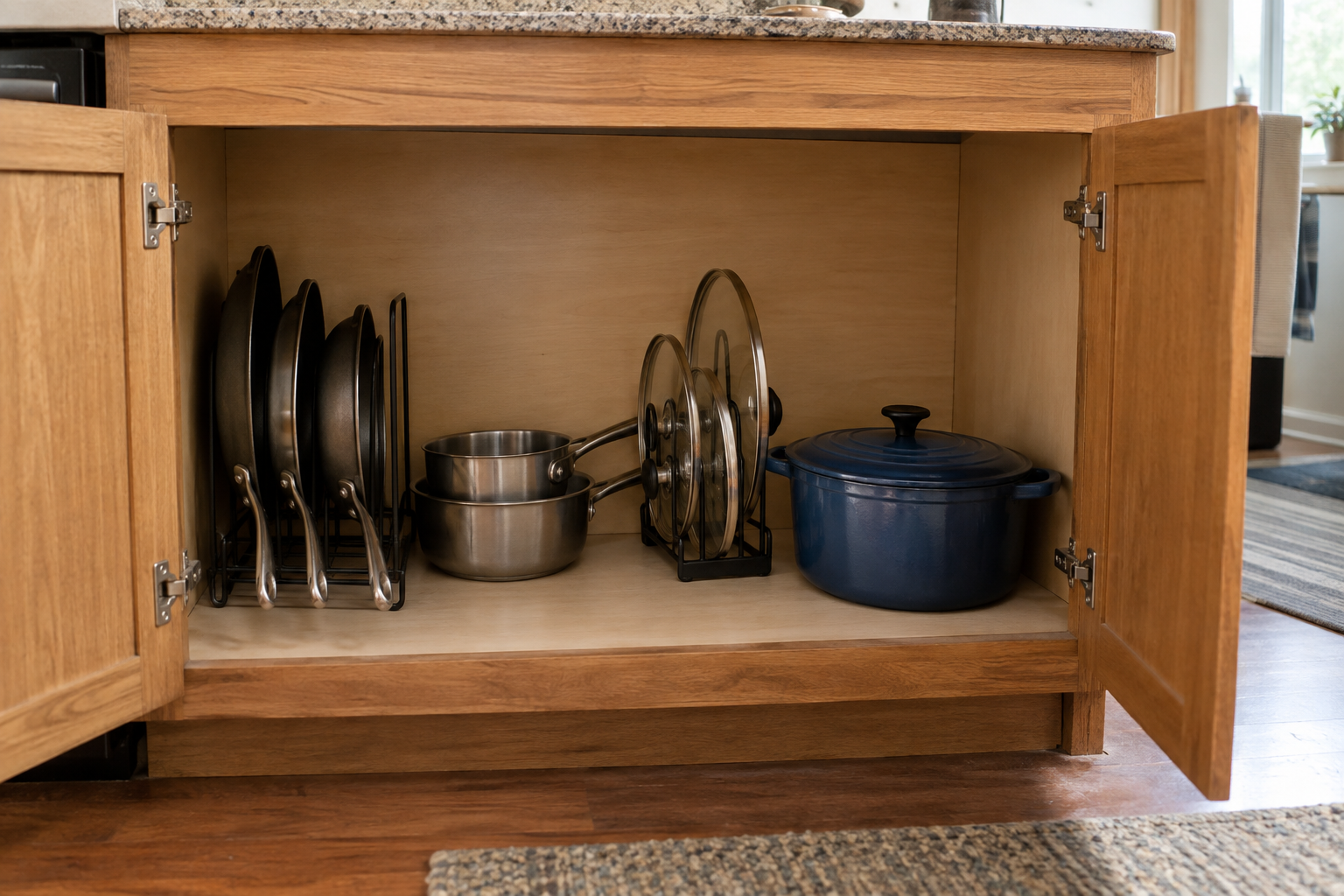
Pot and pan storage in a small rental kitchen works best when you reduce lifting, keep heavy cookware low, and make the pieces you use most often easy to remove without unloading an entire stack. Renters usually get the best results from freestanding racks, removable dividers, low cabinet zones, deep drawers, shelf risers, and portable carts rather than permanent rails or wall-mounted systems.
The main challenge is that cookware is heavy, bulky, and awkwardly shaped. A storage method that looks efficient can still fail if pan handles block the cabinet door, lids slide behind a stack, or the largest pot has to be moved every time you need a small skillet.
This guide covers 10 renter-friendly no-drill ideas, a practical weight-and-access test, how to decide between stacking and vertical storage, and the common mistakes that make pot-and-pan storage less usable.
Measure the Cookware and the Storage Opening First
Before buying a rack or organizer, measure the cabinet or drawer opening as well as the interior. A rack can fit inside a cabinet but still fail if a pan handle, lid, hinge, or face frame prevents normal removal.
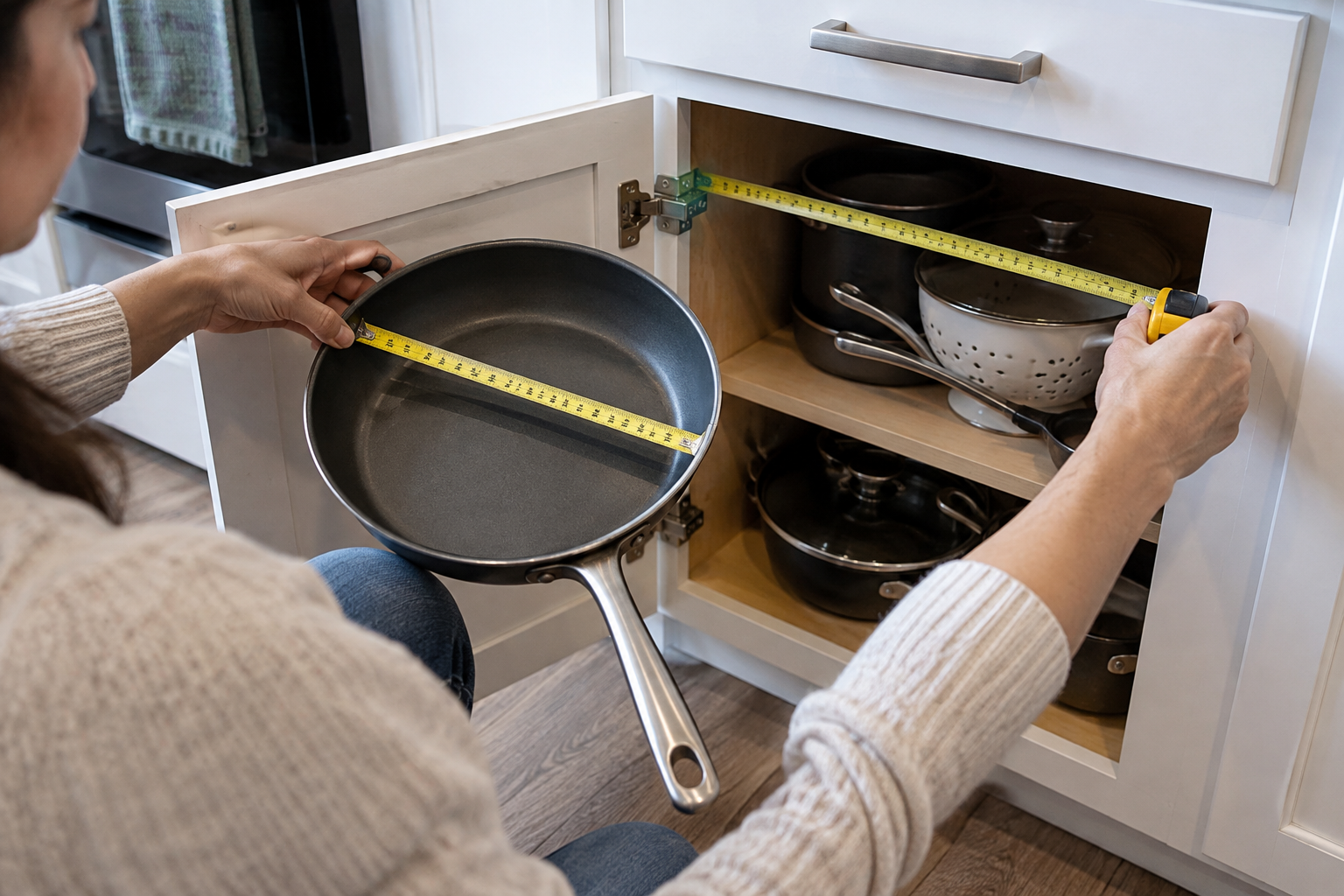
Check these dimensions:
- Cabinet or drawer opening: Measure the narrowest usable width at the front.
- Interior depth: Include space for pan handles and lid knobs.
- Vertical clearance: Check whether stacked pots or upright pans will clear the shelf above.
- Cookware diameter: Measure the largest skillet, sauté pan, and pot rather than assuming a rack fits every size.
- Handle length: A pan body may fit while its handle blocks the door.
- Lid height: Domed lids and tall knobs often need more clearance than flat lids.
RenterRefine practical rule: If getting one everyday pan requires lifting a heavy stack, moving several lids, or twisting cookware around a cabinet frame, the storage system is too complicated for that location.
10 Pot and Pan Storage Ideas for Renters
1. Use a Freestanding Vertical Pan Rack
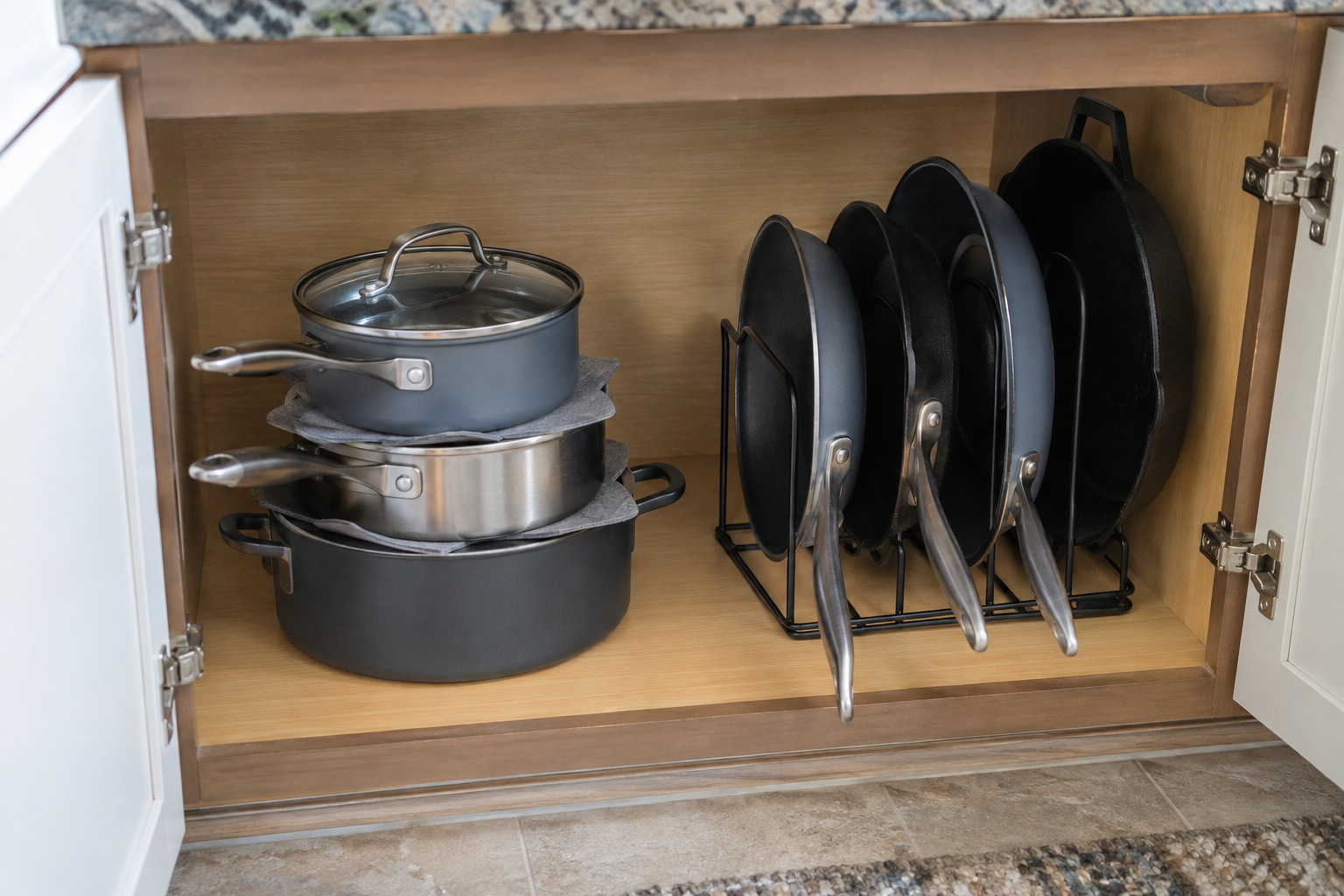
A freestanding rack can hold frying pans, sauté pans, cutting boards, or shallow cookware vertically inside a lower cabinet. Vertical storage can make each piece easier to remove because you do not have to lift everything above it.
Choose a rack with slots wide enough for your actual cookware and a base that stays stable when one pan is removed. Heavier pans belong in the lowest or most supported positions.
2. Keep Everyday Pans in the Easiest-Reach Lower Cabinet
The skillet or saucepan you use several times a week should not be buried behind specialty cookware. Give frequent-use pieces the front or most accessible section of a lower cabinet.
This does not require another organizer. Simply assigning prime cabinet space by frequency can reduce lifting and searching more effectively than adding extra racks.
3. Stack Only When the Stack Stays Short
Stacking is efficient when two or three compatible pots or pans nest securely and the pieces are not excessively heavy. It becomes frustrating when the stack grows tall enough that the lower cookware is difficult to reach.
Use pan protectors or soft separators where appropriate to reduce direct surface contact, especially with cookware finishes that can scratch. Follow the cookware manufacturer’s care instructions rather than assuming every finish can be nested the same way.
4. Store Lids Separately in a Freestanding Lid Rack
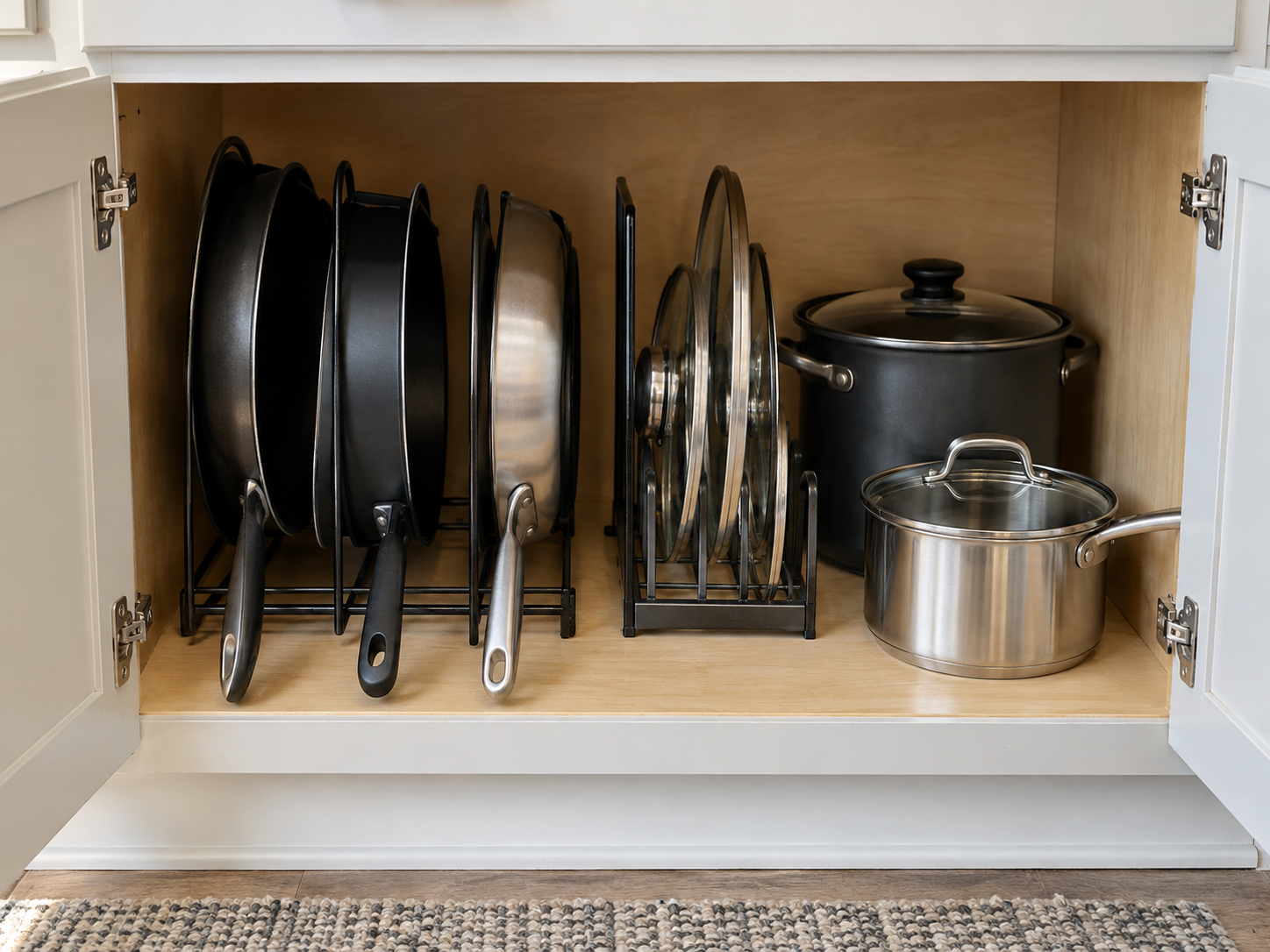
Lids often create more clutter than the pans themselves. A freestanding lid rack can keep them upright in a lower cabinet, deep drawer, or pantry zone without attaching anything permanently.
Group lids by diameter or by the cookware they match. Remove lids that no longer belong to any pan rather than giving unmatched pieces permanent storage space.
5. Use a Deep Drawer for Heavy Cookware if the Drawer Is Suitable
A deep lower drawer can make heavy pots easier to reach because the cookware comes toward you instead of sitting behind a cabinet door.
Do not overload the drawer. Consider the drawer hardware, cookware weight, and manufacturer guidance for the cabinetry where available. Keep the heaviest pieces low and balanced rather than concentrated at the front edge.
6. Use a Low Shelf Riser for Smaller Pots
A sturdy freestanding riser can create two short levels inside a cabinet for smaller saucepans or lightweight cookware, using vertical space that might otherwise be wasted.
This works only when both levels remain easy to access. If the upper tier forces you to crouch, reach behind cookware, or lift a heavy pot above shoulder level, choose a different arrangement.
7. Use a Rolling Cart for Overflow Cookware
If cabinet space is genuinely insufficient, a stable rolling cart can hold stockpots, Dutch ovens, baking dishes, or other bulky cookware without drilling.
Choose a cart with an appropriate load rating and locking casters where applicable. Store heavier cookware on the lowest level. Our guide to freestanding kitchen shelving for renters covers stability and load-placement principles that also apply to portable storage furniture.
8. Create a Dedicated Cookware Zone Instead of Spreading Pieces Around
Keeping pans in one cabinet, lids in another, and large pots across the kitchen can make cooking slower even if each area looks organized. Try to keep related cookware within the same general zone.
A practical zone might place pans in a vertical rack, lids beside them, and larger pots on the cabinet floor. The exact layout matters less than being able to retrieve a complete cooking setup without searching multiple locations.
9. Move Specialty Cookware Out of Prime Cabinet Space
A roasting pan, oversized stockpot, wok, or specialty baking vessel used only occasionally does not need the easiest-reach position. Move infrequently used cookware to a secondary shelf, pantry zone, or other appropriate storage area if it can be retrieved safely.
Do not place very heavy cookware on a high shelf simply to free lower space. Frequency matters, but weight and safe retrieval matter more.
10. Keep One Open Landing Area for Cookware Changes
Leaving a small open section in the cookware cabinet or nearby storage zone gives you somewhere to place a new pan, temporary lid, or recently added piece without immediately rebuilding the entire system.
If that open area repeatedly disappears under unrelated kitchen items, treat it as a sign that the cabinet needs editing rather than another organizer.
Vertical Storage vs. Stacking: Which Is Better?
| Method | Best For | Main Advantage | Main Drawback |
|---|---|---|---|
| Vertical rack | Frying pans, shallow cookware | Individual access | Requires enough cabinet height and slot width |
| Short stack | Nesting pots or pans | Uses less horizontal space | Lower pieces require lifting |
| Deep drawer | Heavy cookware | Pull-forward access | Drawer load and clearance matter |
| Low shelf riser | Smaller pots | Uses vertical space | Can reduce visibility if overfilled |
| Rolling cart | Overflow cookware | Portable capacity | Uses floor space |
| Separate lid rack | Loose lids | Improves visibility | Requires a second footprint |
Use a Weight-Reach-Clearance Test
Before assigning a pot or pan to a storage location, test three things:
- Weight: Can you lift or slide it without awkward strain?
- Reach: Can you retrieve it without unloading other heavy cookware?
- Clearance: Can the pan body, handle, and lid move through the opening without hitting hinges, shelves, or other items?
A storage location that fails any one of these tests may look efficient but will probably be frustrating in everyday use.
Storage Should Not Interfere With Safe Cooking
Cookware organization should support a safer cooking area rather than crowd the stovetop. The U.S. Fire Administration advises turning pot handles toward the back of the stove so they are less likely to be bumped or pulled over, and keeping items that can catch fire away from the stovetop. See U.S. Fire Administration cooking fire safety guidance.
For renters, that means cookware racks, lid holders, towels, paper goods, and other stored items should not reduce safe working clearance around cooking surfaces. Let cookware cool appropriately before returning it to storage and follow the cookware manufacturer’s care instructions.
Common Pot and Pan Storage Mistakes
- Stacking too many heavy pans: Efficient-looking stacks can become difficult to lift safely.
- Ignoring handle length: The pan body may fit while the handle prevents the cabinet from closing.
- Mixing lids into unstable stacks: Separate lids when they slide or make pan retrieval harder.
- Buying a vertical rack before measuring slot width: Thick handles and deep pans may not fit standard dividers.
- Putting heavy cookware high: Saving lower space is not worth creating awkward overhead retrieval.
- Overloading a drawer or cart: Physical space does not equal safe load capacity.
- Keeping specialty cookware in prime space: Easy-reach storage should favor pieces used most often.
How to Organize Pots and Pans Step by Step
- Take out all pots, pans, and lids from the main storage area.
- Group cookware by type and how often you use it.
- Remove damaged, duplicate, or unused pieces you no longer need.
- Measure the cabinet or drawer opening, depth, height, handle clearance, and largest cookware diameter.
- Give everyday cookware the easiest lower access.
- Choose vertical storage for individual access or short stacks for cookware that nests safely.
- Store lids separately if they make stacks unstable.
- Move specialty cookware to secondary storage without placing heavy pieces too high.
- Open and close every cabinet or drawer after loading to check handles, hinges, and clearance.
If you need more removable cabinet organization, see kitchen cabinet storage without drilling. For cookware that has to move outside the cabinets, see freestanding kitchen shelving. For the broader kitchen plan, start with kitchen storage without drilling.
Frequently Asked Questions
What is the best way to store pots and pans in a small rental kitchen?
Use the easiest lower storage for frequent cookware, keep stacks short, use a freestanding vertical rack when individual access matters, and store lids separately if they make the main stack unstable.
Is vertical pot and pan storage better than stacking?
Vertical storage is often better when you want to remove one pan without lifting others. Stacking can use less horizontal space when cookware nests securely and the stack remains short enough to manage comfortably.
Where should heavy cookware be stored?
Heavy cookware is generally more practical in stable lower storage where it can be lifted or slid out without awkward overhead reaching. Also respect the load guidance for drawers, shelves, carts, and organizers.
How should pot lids be organized?
Use a freestanding lid rack, deep-drawer divider, or clearly defined cabinet zone. Group lids by size or matching cookware, and remove unmatched lids that no longer serve a purpose.
Can renters use hanging pot racks?
A permanently mounted hanging rack usually requires secure structural installation and may conflict with rental restrictions. This guide focuses on freestanding, removable solutions that do not depend on drilling or uncertain adhesive load support.
Final Thoughts
Pot and pan storage in a rental kitchen should reduce lifting and searching, not maximize the number of pieces squeezed into one cabinet. The strongest no-drill systems are usually simple: short stacks, vertical racks, separate lid storage, lower drawers, freestanding shelves, or a stable rolling cart.
Measure the cookware and the cabinet opening, keep heavy pieces low, give everyday pans prime access, and choose a layout that lets you remove one item without rebuilding the whole cabinet.
If the system looks tidy but makes cooking slower or lifting harder, it needs to be simplified.