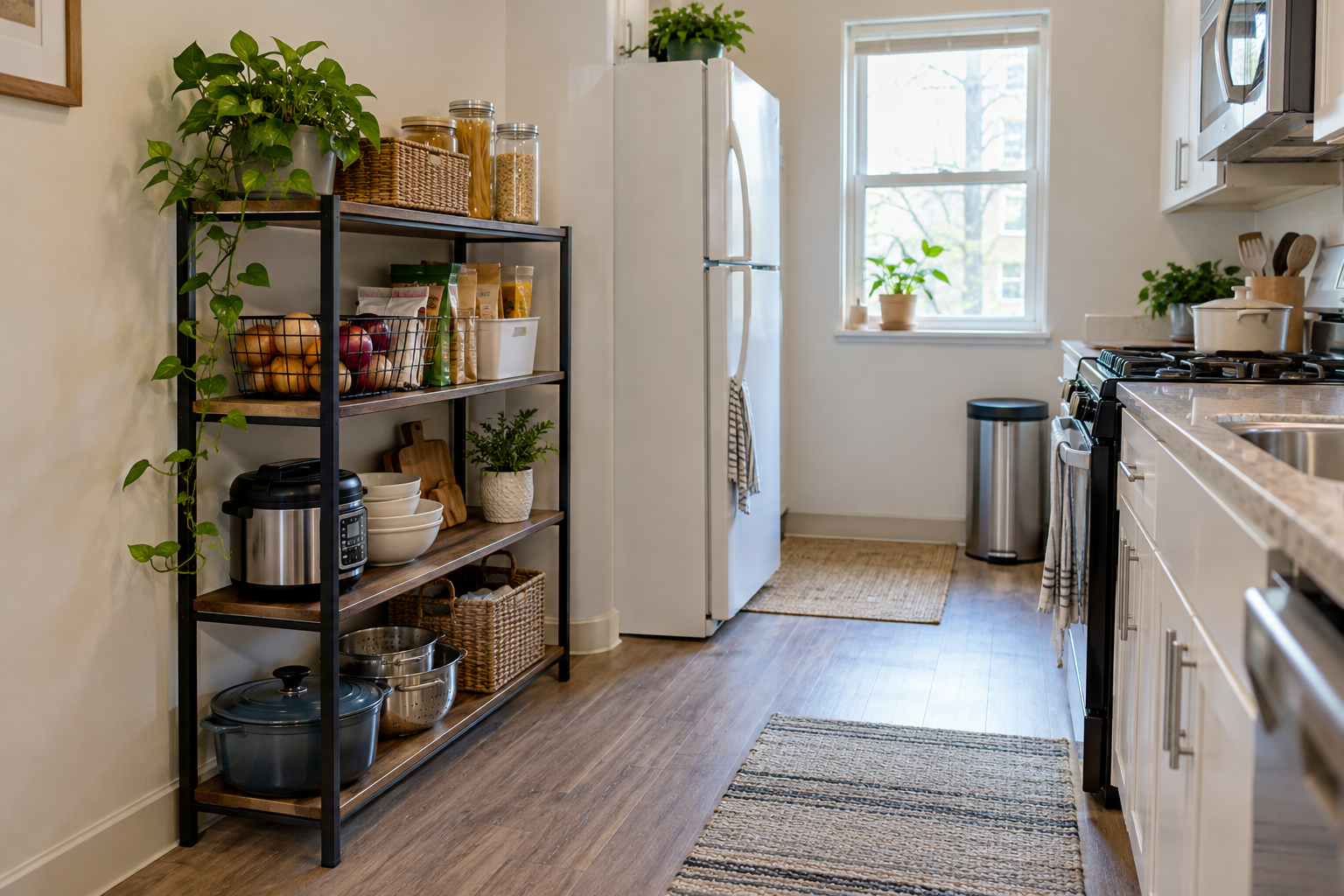
Freestanding kitchen shelving can give renters extra storage without drilling into walls or cabinets. A well-chosen shelf can hold pantry goods, small appliances, cookware, baskets, or everyday supplies while remaining portable when you move.
The challenge is choosing a unit that fits the kitchen safely. Narrow spaces can tempt renters toward tall, slim shelves, but height, depth, weight distribution, floor level, and the manufacturer’s anti-tip instructions all matter. A shelf that technically fits a gap is not useful if it blocks a walkway, interferes with an appliance door, or becomes unstable when loaded.
This guide covers nine renter-friendly freestanding shelving ideas, what to measure before buying, how to choose between common shelf types, and when a supposedly “no-drill” setup may still require extra safety precautions.
Before Buying Freestanding Kitchen Shelving, Measure the Whole Footprint
Measure more than the empty floor space. A shelf needs enough room to stand, enough clearance to use, and enough space around nearby doors and appliances.
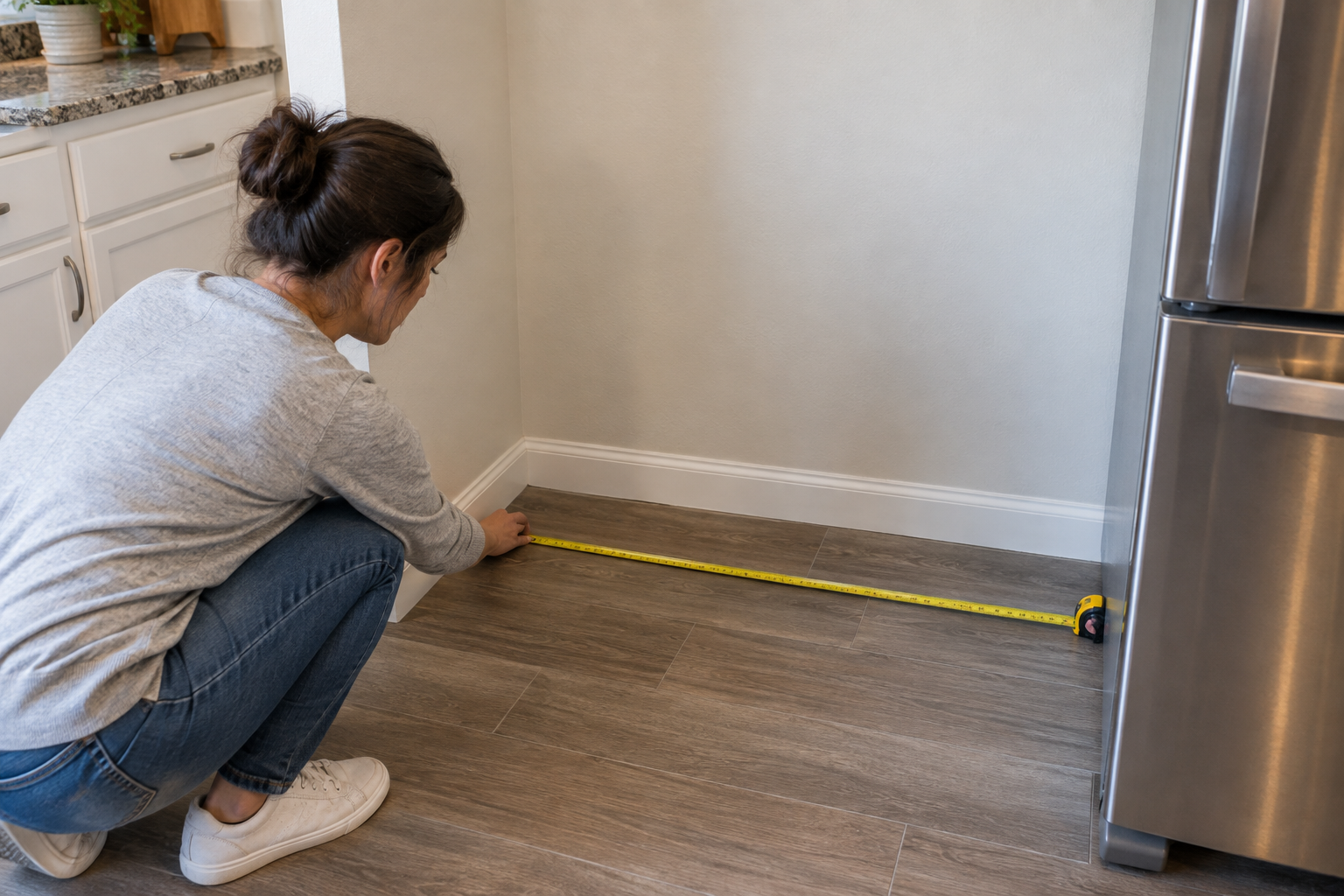
Check these dimensions before buying:
- Width: Measure the narrowest point, including baseboards, trim, cabinet overhangs, and refrigerator handles.
- Depth: Make sure the shelf does not project too far into a walkway or work area.
- Height: Check ceilings, upper cabinets, switches, windows, vents, and anything mounted above the intended location.
- Door swing: Open nearby cabinet, refrigerator, oven, dishwasher, pantry, and room doors fully.
- Walking clearance: Leave enough room for normal movement through the kitchen rather than filling every available inch.
- Floor condition: Uneven tile, thresholds, rugs, or sloped floors can affect stability.
Renter tip: Treat the manufacturer’s assembly, loading, and anti-tip instructions as part of the product’s safe setup. If a tall unit requires wall anchoring, skipping that step does not turn it into a safe no-drill shelf. Choose a different shelf or get landlord approval for the required restraint.
9 Freestanding Kitchen Shelving Ideas for Renters
1. Use a Low, Wide Shelf Against an Empty Wall
A low, wide shelving unit can add storage without dominating a small kitchen. Because the center of gravity is lower than on a tall narrow tower, this format can also be easier to place and access.
Use lower shelves for heavier items and upper shelves for lighter baskets or frequently used supplies. Keep enough space above the unit if you plan to use the top as an additional surface.
2. Fit a Narrow Shelf Beside the Refrigerator
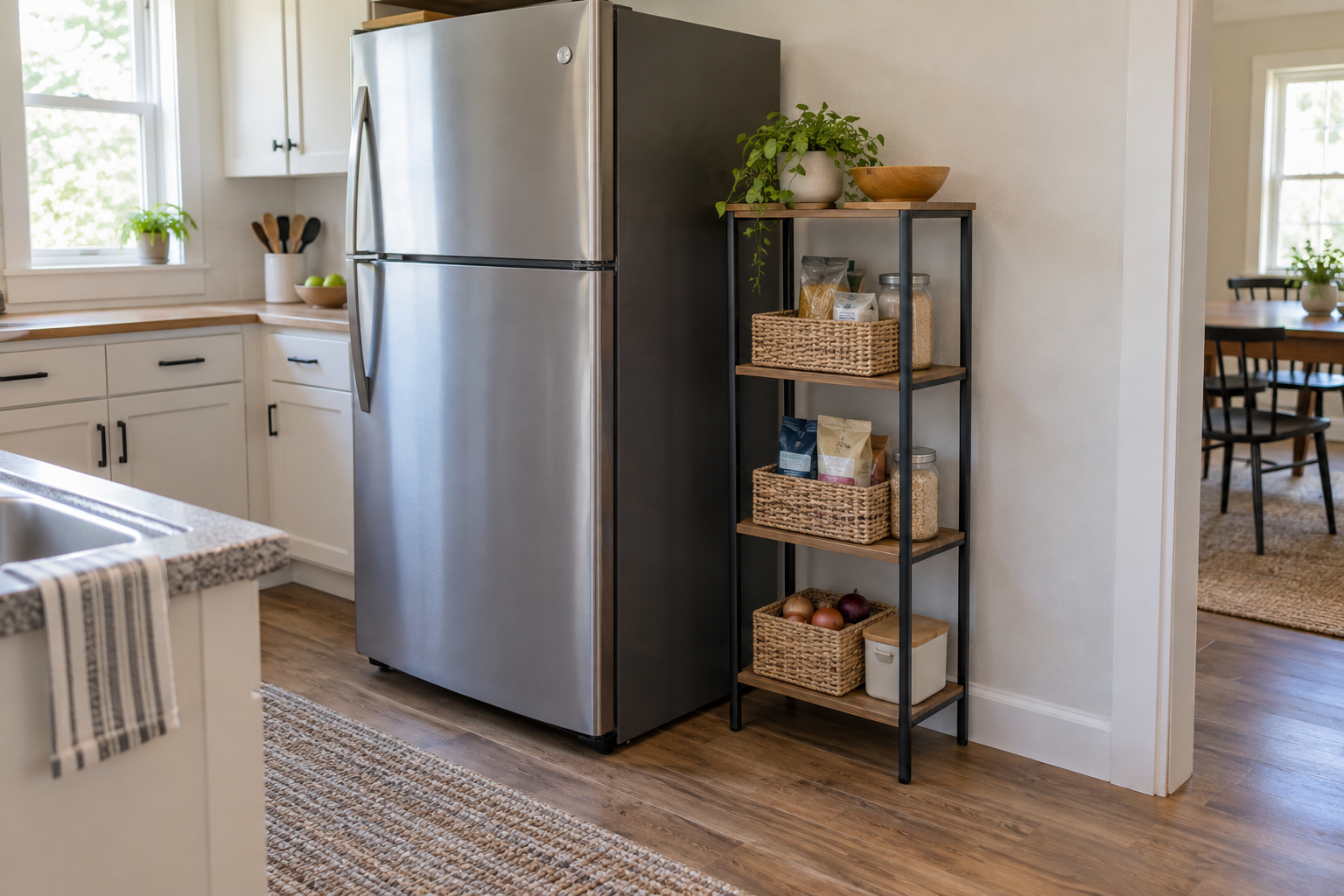
The gap beside a refrigerator is often one of the few unused zones in a rental kitchen. A narrow freestanding shelf can hold pantry items, bottles, wraps, or baskets without touching the wall.
Measure carefully. Leave clearance for the refrigerator door, ventilation requirements, plugs, water lines, and normal cleaning access. Extremely narrow, tall units can be less stable, so check the manufacturer’s safety instructions before assuming the space is suitable.
3. Add a Compact Baker’s Rack
A compact baker’s rack combines open shelves with a work-height surface. It can be useful for a microwave, coffee equipment, mixing bowls, pantry containers, or everyday kitchen supplies when counter space is limited.
Check the shelf material, heat clearance, electrical access, and the manufacturer’s stated load limits before placing appliances on it. Do not route cords where they cross walkways or rest against hot surfaces.
4. Use a Rolling Cart With Shelves
A rolling cart can provide temporary shelving that moves to where you need it. It can serve as pantry overflow, a coffee station, a baking cart, or storage for lightweight cookware.
Choose locking casters if the cart will be used near a work surface. Keep heavier items on the lower levels and avoid leaving the cart in a doorway or narrow traffic path.
5. Use a Freestanding Corner Shelf
A corner shelf can make use of a spot that is too awkward for a rectangular cabinet or cart. This works best when the corner is outside the main cooking and walking zone.
Measure the usable corner depth and check whether the shelf shape leaves enough room to reach every level. Avoid placing a unit where it narrows the entrance to the kitchen or blocks a cabinet door.
6. Choose a Wire Utility Rack for Adjustable Shelf Heights
Freestanding wire racks can be useful when you need adjustable vertical spacing. You can position shelves to suit tall pantry containers, small appliances, baskets, or cookware instead of accepting fixed shelf heights.
Before buying, check overall dimensions, shelf load limits, and whether the feet can be leveled on your kitchen floor. Add shelf liners if small items would otherwise tip between the wires.
7. Use a Small Kitchen Island Cart With Open Shelves
In a kitchen with enough floor space, a compact island cart can combine a work surface with open storage underneath. This may be more useful than a tall shelf when you need both preparation space and storage.
Measure the walking route on all sides before buying. The cart should not interfere with the refrigerator, oven, dishwasher, or main path through the room.
8. Create a Pantry Zone With Matching Baskets
A freestanding shelf becomes easier to use when loose packages are grouped into baskets by category. For example, keep breakfast items, snacks, baking supplies, or backup pantry goods together instead of stacking unrelated packages across every shelf.
Use baskets that fit the shelf depth without hanging over the edge. Labeling can help, but even simple visual grouping makes an open shelf look calmer and makes stock easier to check.
9. Use a Short Shelf as Appliance Overflow
A short freestanding shelf can move rarely used small appliances off the main countertop while keeping them accessible. It may work for a rice cooker, blender, toaster, or mixer if the shelf is rated for the weight and the appliance is stored safely.
Do not operate heat-producing appliances in a location that lacks the clearances required by the appliance manufacturer. In many cases, the shelf is best used for storage rather than operation.
Which Freestanding Kitchen Shelf Type Fits Your Space?
| Shelf Type | Best For | Main Advantage | Main Check |
|---|---|---|---|
| Low, wide shelf | Pantry goods and baskets | Easy access and lower profile | Floor footprint |
| Narrow shelf | Gap beside refrigerator | Uses otherwise wasted space | Stability and appliance clearance |
| Baker’s rack | Appliances and pantry overflow | Storage plus work surface | Load rating and heat clearance |
| Rolling cart | Flexible storage | Moves when needed | Locking casters and traffic flow |
| Corner shelf | Unused corners | Uses awkward space | Reach and doorway clearance |
| Wire utility rack | Mixed-height items | Adjustable shelves | Leveling and load limits |
| Island cart | Storage plus prep space | Multi-purpose surface | Walking clearance |
Safety Matters With Tall Freestanding Shelving
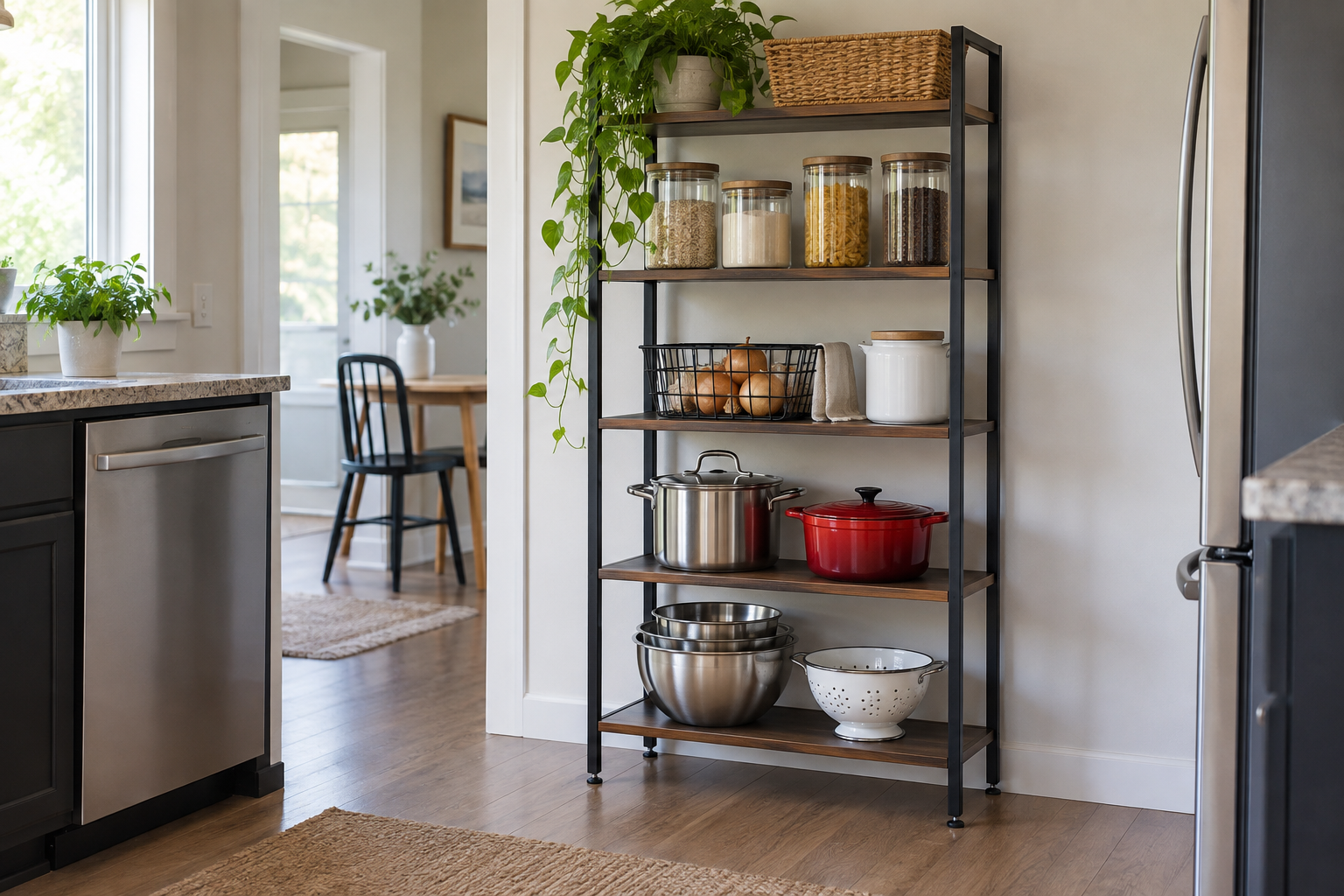
Tall shelving can create a tip-over hazard, especially in homes with children. The U.S. Consumer Product Safety Commission advises consumers to secure top-heavy furniture and follow manufacturer instructions for anti-tip protection. Its Anchor It! guidance provides more information about furniture tip-over prevention.
For renters, this means a tall shelf that requires wall anchoring may not be the right “no-drill” solution unless your landlord allows the required restraint. A lower, wider unit may be more appropriate when permanent wall attachment is not permitted.
- Place heavier items on lower shelves.
- Do not exceed the manufacturer’s shelf or total load limits.
- Use leveling feet correctly if the unit includes them.
- Keep climbing temptations away from children.
- Do not ignore anti-tip hardware simply because you are renting.
What Should You Store on Freestanding Kitchen Shelves?
The most practical items are those that fit the shelf safely and benefit from easier access. Depending on the unit, you might store:
- pantry baskets and packaged foods
- small appliances within the shelf’s load limits
- mixing bowls and lightweight cookware
- paper goods and food-storage supplies
- coffee or tea supplies
- backup kitchen essentials
Keep fragile, very heavy, or hazardous items where they cannot fall easily. Open shelves are visible and convenient, but they should not become a catch-all for anything that lacks another home.
Common Mistakes With Freestanding Kitchen Shelving
- Choosing height before stability: A taller unit is not automatically a better use of vertical space.
- Ignoring door swing: A shelf may fit the wall but block an appliance or cabinet when the door opens.
- Overloading upper shelves: Keep heavier items low and follow the manufacturer’s limits.
- Blocking ventilation: Do not crowd refrigerator vents or other appliance clearance zones.
- Using the shelf as an appliance operating station without checking clearances: Storage and operation have different safety needs.
- Skipping anti-tip requirements: If the manufacturer requires anchoring, treat it as part of the safe installation.
- Filling the walkway: Extra storage is not useful if it makes the kitchen harder to move through.
How to Choose Freestanding Kitchen Shelving Step by Step
- Decide what you actually need to store and estimate the total weight.
- Choose the intended location before shopping.
- Measure width, depth, height, door swing, and walking clearance.
- Compare low and wide options before choosing a tall narrow unit.
- Check shelf-by-shelf and total load ratings.
- Review the manufacturer’s assembly and anti-tip instructions.
- Place heavy items low and lighter items higher.
- After loading, check stability, level, appliance clearance, and traffic flow again.
For a broader plan, start with our main guide to kitchen storage without drilling. If you want to use door space instead of floor space, see over-the-door kitchen storage for renters. For smaller pantry items, our guide to no-drill spice rack ideas covers cabinet, drawer, magnetic, and freestanding options.
Frequently Asked Questions
Is freestanding kitchen shelving renter-friendly?
Yes, many freestanding shelves are renter-friendly because they do not require permanent cabinet or wall modification. However, you should still follow the manufacturer’s safety instructions, including any required anti-tip restraint.
What type of freestanding shelf is best for a small kitchen?
It depends on the available footprint. A low wide shelf, narrow refrigerator-gap unit, compact baker’s rack, rolling cart, or corner shelf can work well if it leaves enough walking and appliance clearance.
Can I use a tall shelving unit without anchoring it?
Follow the manufacturer’s instructions. If the unit requires anti-tip anchoring, do not skip that requirement. Renters who cannot make the required attachment should choose another unit or seek landlord approval for the recommended restraint.
Can a freestanding shelf go beside the refrigerator?
It can if there is enough width, ventilation, door clearance, plug and water-line access, and room for cleaning. Check the refrigerator manufacturer’s clearance requirements as well as the shelf dimensions.
What should go on the bottom shelf?
Heavier items are generally better placed lower because that can help keep the unit’s center of gravity down. Stay within the manufacturer’s stated limits and avoid storing anything hazardous where children can reach it.
Final Thoughts
Freestanding kitchen shelving can be one of the most flexible ways for renters to add storage because it uses floor space instead of permanent wall or cabinet modifications.
The best unit is not simply the tallest shelf that fits. Measure the full footprint, protect appliance and walking clearances, keep heavier items low, and treat any anti-tip requirement as part of the safe setup.
When the shelf matches the room, the load, and the manufacturer’s instructions, it can add practical kitchen storage while remaining portable for your next rental.