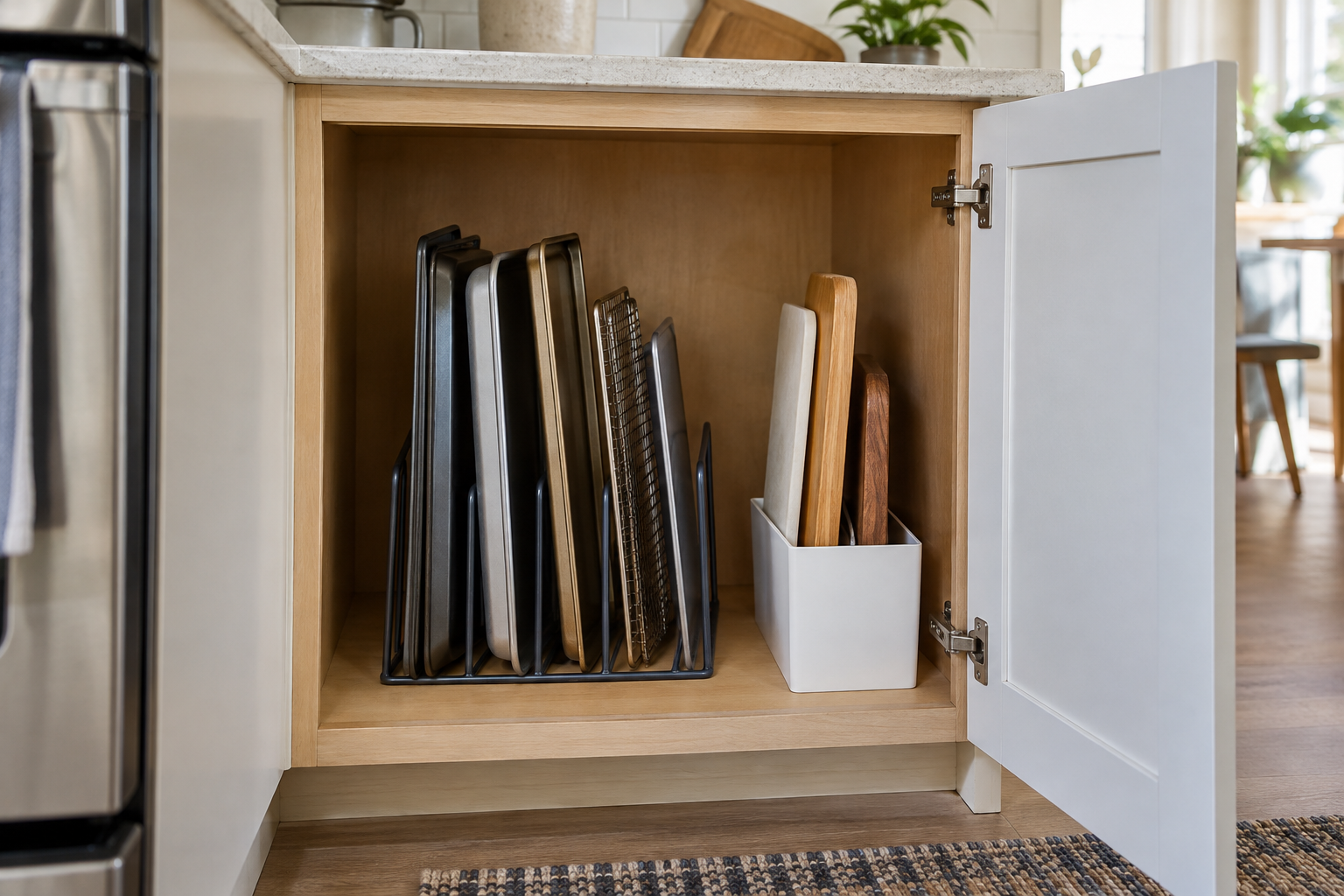
Baking sheet storage in a small rental kitchen works best when flat items can be removed one at a time without unloading an entire stack. Baking sheets, cutting boards, cooling racks, muffin tins, and trays look space-efficient because they are thin, but their handles, rims, width, and height often make them awkward to store in ordinary cabinets.
For renters, the most useful solutions are usually removable: freestanding vertical racks, adjustable dividers, tension dividers, deep drawers, low cabinet zones, or a simple short stack. The right method depends less on how many pieces you own and more on whether each item can pass through the cabinet opening and come out cleanly.
This guide covers 10 no-drill ideas, a practical flat-item measurement method, vertical-versus-stacked storage trade-offs, cutting-board care, and the common mistakes that make bakeware storage harder to use.
Measure the Largest Flat Item and Its Retrieval Path
Start with the largest baking sheet, tray, cutting board, or cooling rack that must fit the space. Then measure not only the cabinet interior but also the route the item takes through the opening. A cabinet may be tall enough inside but still fail because a face frame, hinge, shelf lip, or nearby handle blocks the removal angle.
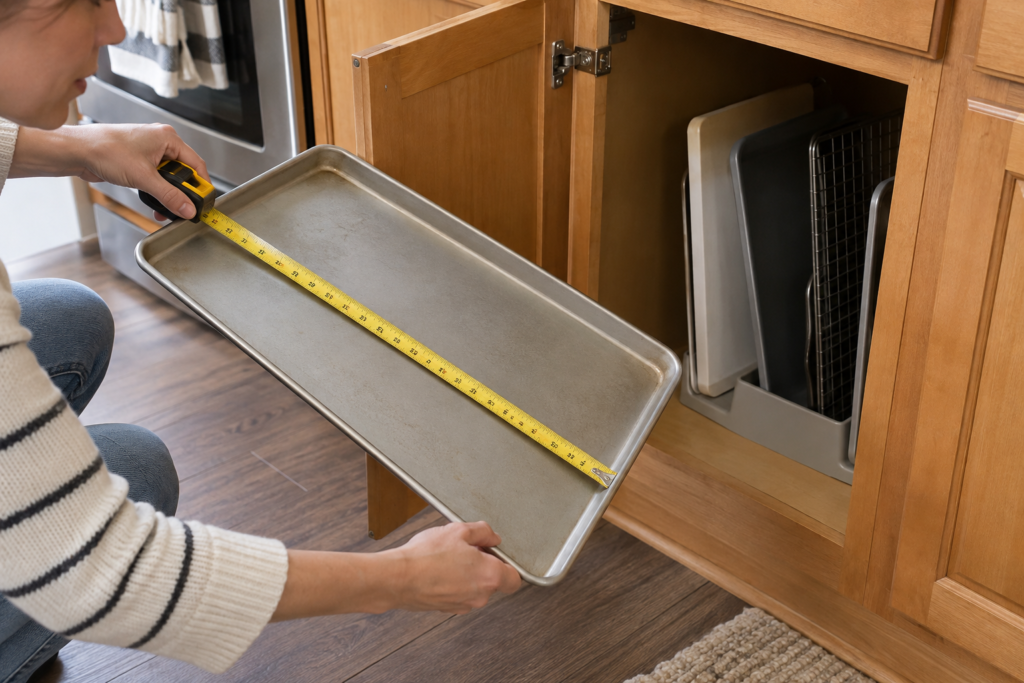
Check these dimensions:
- Cabinet opening width: Measure the narrowest point at the front, not just the interior width.
- Interior height: Include the tallest board, pan rim, or tray handle.
- Interior depth: Make sure long trays do not hit the cabinet back before the door can close.
- Item thickness: Divider slots need enough room for rimmed baking sheets and thicker cutting boards.
- Retrieval angle: Check whether the item can come out vertically or needs room to tilt.
- Door and hinge clearance: Confirm the door opens wide enough to remove the largest item without scraping.
RenterRefine practical rule: Build the storage zone around the largest flat item you actually use. If that piece cannot enter and leave the space in one controlled movement, the organizer is the wrong fit no matter how many smaller items it can hold.
10 Baking Sheet Storage Ideas for Renters
1. Use a Freestanding Vertical Bakeware Rack
A freestanding rack can store baking sheets, trays, cooling racks, and cutting boards upright like files inside a lower cabinet. This gives each piece its own retrieval path and avoids lifting a heavy flat stack.
Choose a rack with a wide, stable base and slots that fit the thickest item. Narrow wire slots may work for cooling racks but fail with thick wooden cutting boards or rimmed sheet pans.
2. Create Wider and Narrower Divider Slots
Not every flat item has the same thickness. Use wider slots for cutting boards, muffin tins, or rimmed pans and narrower slots for cooling racks or flat trays.
A rack with identical narrow spacing can look efficient but force thick pieces to lean outside the organizer. Mixed slot widths usually produce a more usable setup.
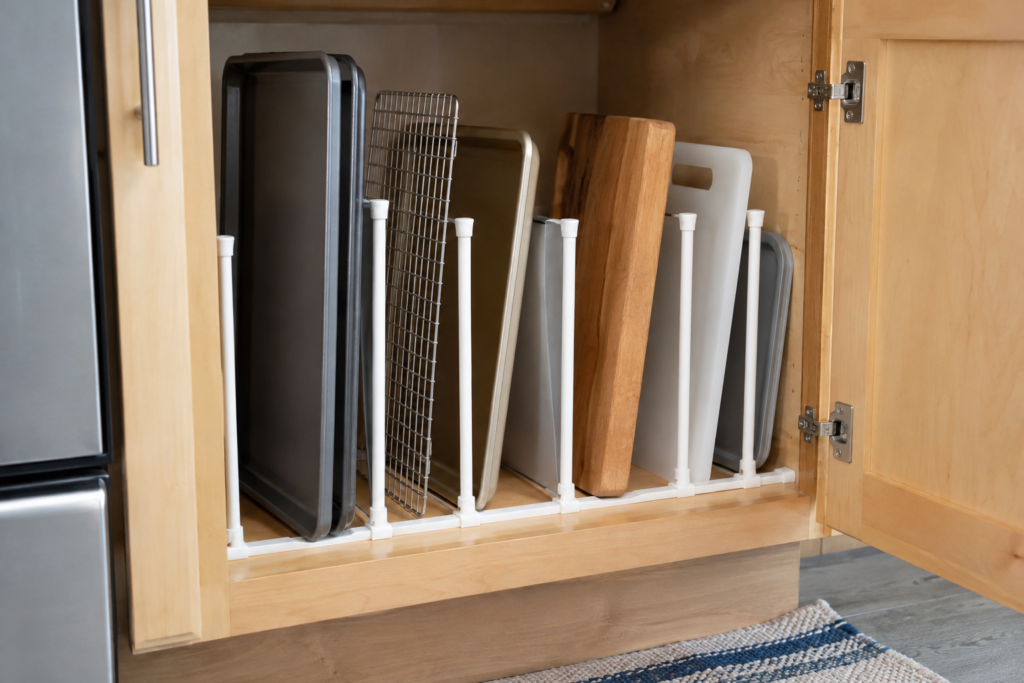
3. Use Removable Tension Dividers in a Suitable Cabinet
Small tension dividers can create vertical sections without screws when the cabinet has suitable opposing surfaces. They can separate baking sheets, boards, trays, and cooling racks.
Use only enough tension to keep the dividers stable. They are not structural shelving, and excessive pressure against thin cabinet panels is unnecessary. Follow the divider manufacturer’s intended use and load guidance.
4. Keep a Short Horizontal Stack for Similar Trays
Vertical storage is not always necessary. If two or three lightweight trays nest neatly and the bottom piece is still easy to retrieve, a short horizontal stack can use less cabinet width.
Keep the stack short. Once you routinely have to lift several heavy or awkward pieces to reach the bottom item, vertical storage becomes more practical.
5. Use a Deep Drawer for Flat Bakeware if the Drawer Fits
A deep lower drawer can work well for baking sheets and cutting boards because it brings the whole group toward you and gives a clear top-down view.
Check drawer height, runner capacity, and item length. A sheet pan that is slightly too tall may catch the cabinet frame when the drawer closes even though it fits inside the drawer box.
6. Use a Narrow Lower-Cabinet Zone Beside Cookware
If your lower cabinet already stores pots and pans, reserve one narrow vertical section for flat items instead of laying baking sheets underneath heavy cookware.
This keeps the two storage types from interfering with each other. Our guide to pot and pan storage for renters explains how to keep heavy cookware low while preserving individual access.
7. Keep Cutting Boards in Their Own Easy-Clean Zone
Cutting boards can share a vertical rack with bakeware when they fit cleanly, but they benefit from a defined section so they can be returned after washing and drying without leaning against every pan.
The USDA Food Safety and Inspection Service recommends washing cutting boards with hot, soapy water after each use, rinsing, and air-drying or pat-drying them; heavily worn boards with hard-to-clean grooves should be replaced. See USDA FSIS cutting-board guidance.
8. Group Flat Items by Frequency of Use
Place the baking sheet, cutting board, or tray you use most often in the easiest-to-reach slot. Specialty roasting trays, oversized boards, and occasional bakeware can sit farther back or in secondary storage.
This reduces searching without requiring another organizer. Prime slots should go to high-frequency pieces, not simply the smallest or most attractive ones.
9. Move Rarely Used Oversized Pieces to Secondary Storage
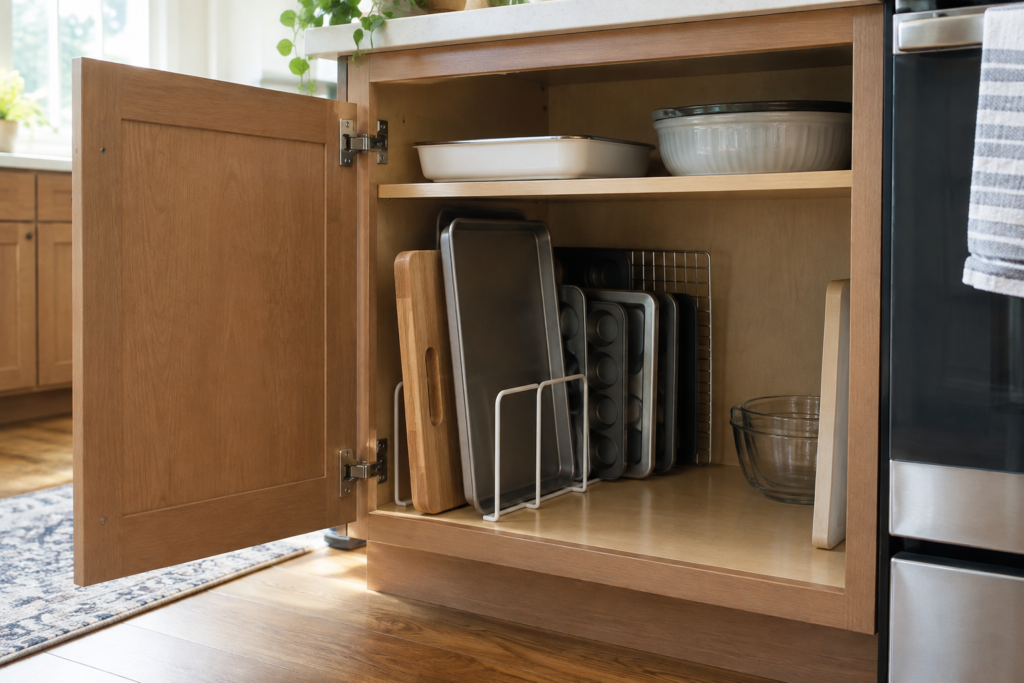
An oversized roasting tray or specialty board used only a few times a year does not need prime cabinet space. A suitable pantry shelf, freestanding unit, or other secondary storage area may be a better fit if the item remains clean, dry, and safely accessible.
Do not store a heavy item high simply because it is rarely used. Retrieval safety still matters more than frequency.
10. Keep One Flexible Slot for New or Odd-Shaped Items
Leave one slightly wider slot or small open section for an unusually thick cutting board, new tray, or item that does not fit the main spacing.
If the flexible slot becomes permanently packed, repeat the flat-item audit before adding another organizer. Overflow is useful feedback that the category may be growing beyond the available space.
Vertical Storage vs. Horizontal Stacking
| Method | Best For | Main Advantage | Main Drawback |
|---|---|---|---|
| Freestanding vertical rack | Baking sheets, boards, racks | Individual access | Uses cabinet width |
| Tension dividers | Mixed flat items | Adjustable spacing | Depends on suitable cabinet surfaces |
| Short horizontal stack | Similar lightweight trays | Compact footprint | Bottom items require lifting |
| Deep drawer | Mixed everyday bakeware | Top-down visibility | Height and drawer load matter |
| Narrow cabinet zone | Flat items beside cookware | Uses awkward vertical space | Opening width can limit fit |
| Secondary shelf | Oversized occasional pieces | Preserves prime space | Must remain safely accessible |
Use a Fit-Support-Retrieval Test
Before choosing a storage method, test three things:
- Fit: Does the largest item pass through the cabinet or drawer opening?
- Support: Does the rack or divider keep the item upright without bending, sliding, or leaning heavily?
- Retrieval: Can you remove one everyday piece without unloading the rest?
If one of those tests fails, change the orientation, slot width, or storage location. A compact arrangement is not useful if the largest tray cannot come out cleanly.
Common Baking Sheet Storage Mistakes
- Measuring only the cabinet interior: The front opening and retrieval angle matter just as much.
- Using identical narrow slots: Thick boards and rimmed pans often need wider spacing.
- Building a tall flat stack: The bottom item becomes difficult to reach.
- Over-tightening tension dividers: Use only enough pressure for stability.
- Storing boards before they are dry: Clean and dry them according to care and food-safety guidance before returning them to storage.
- Giving oversized specialty pieces prime space: Easy-reach slots should favor items used most often.
- Ignoring the cabinet door: Long tray edges and handles can stop the door from closing.
How to Organize Baking Sheets and Cutting Boards Step by Step
- Remove all baking sheets, trays, racks, boards, and similar flat items from the storage area.
- Group them by type, thickness, and frequency of use.
- Remove damaged or unused pieces you no longer need.
- Measure the largest item and the narrowest point of the cabinet or drawer opening.
- Choose vertical storage when individual access matters or a short stack when similar lightweight pieces nest easily.
- Create wider slots for thicker boards and narrower slots for thin racks or trays.
- Put everyday items in the easiest-reach positions.
- Keep cutting boards clean and dry before storage.
- Move oversized occasional pieces to suitable secondary storage if needed.
- Open and close the cabinet or drawer after loading to confirm full clearance.
For broader cabinet organization, see kitchen cabinet storage without drilling. If your deep drawers are the better storage option, see small kitchen drawer organization. For the overall renter-friendly kitchen plan, start with kitchen storage without drilling.
Frequently Asked Questions
What is the best way to store baking sheets in a small kitchen?
A freestanding vertical rack is often useful because it gives each baking sheet its own retrieval path. A short horizontal stack can also work when you have only a few similar lightweight trays.
Can renters store baking sheets vertically without drilling?
Yes. Freestanding bakeware racks, removable dividers, and suitable tension dividers can create vertical storage without permanent installation.
Can cutting boards be stored with baking sheets?
They can share the same cabinet zone if the rack has enough spacing and the boards can be returned clean and dry. A separate wider slot often works better for thicker boards.
Should baking sheets be stacked or stored upright?
Use upright storage when individual access matters or when stacks become heavy. Use a short horizontal stack when only a few lightweight pieces nest cleanly and the bottom item remains easy to reach.
How wide should bakeware divider slots be?
There is no single ideal width. Measure the thickest item you plan to store and allow enough room to remove it without scraping or forcing it. Different slot widths are often more useful than identical spacing.
Final Thoughts
Baking sheet storage in a rental kitchen works best when flat items are organized around fit, support, and retrieval rather than maximum capacity. Renters can usually create a practical system with a freestanding rack, removable dividers, a deep drawer, or a short stack.
Measure the largest piece first, give thicker items wider slots, keep everyday bakeware easiest to reach, and store cutting boards clean and dry.
If one tray cannot come out without moving three others, the storage system is telling you exactly what needs to change.