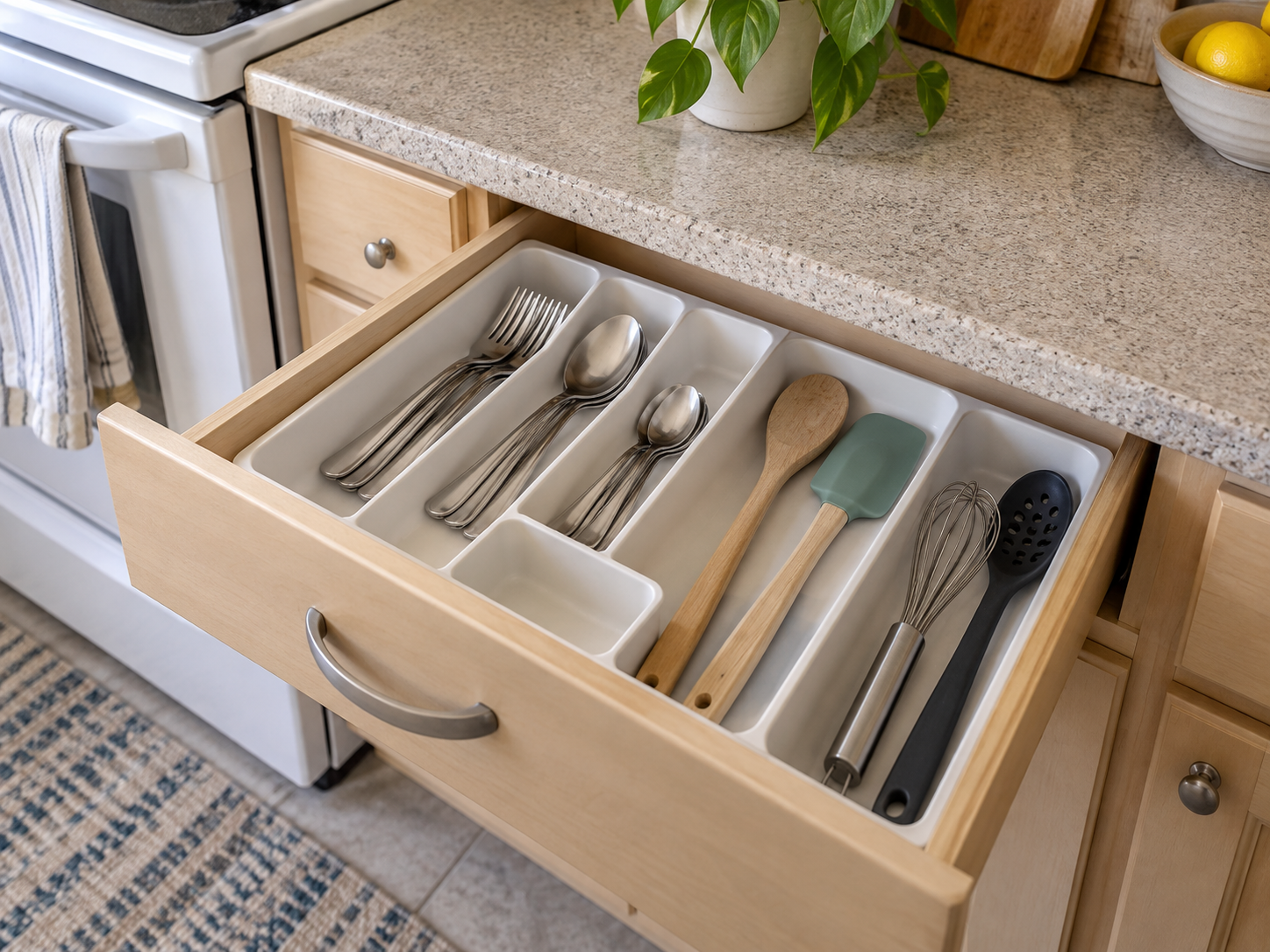
Small kitchen drawer organization is less about fitting more into a drawer and more about reducing wasted motion. A useful renter-friendly drawer should let you see what you own, reach common tools in one movement, and close without catching, jamming, or forcing organizers against the drawer sides.
Because rental drawers vary in width, depth, height, and runner clearance, one-size-fits-all organizers often disappoint. Before buying inserts, measure the usable interior and decide what the drawer actually needs to do. A shallow cutlery drawer, deep utensil drawer, wrap drawer, and spice drawer all benefit from different layouts.
This guide covers 10 no-drill kitchen drawer ideas for renters, a practical drawer-audit method, what to keep out of overcrowded drawers, and the small details that often determine whether an organizer improves the drawer or simply adds another layer of clutter.
Measure the Drawer Before Choosing Organizers
Measure the usable space inside the drawer, not just the front panel. Drawer boxes can be narrower than the face, and slides, sidewalls, handles, and internal lips can reduce the space available for trays or dividers.
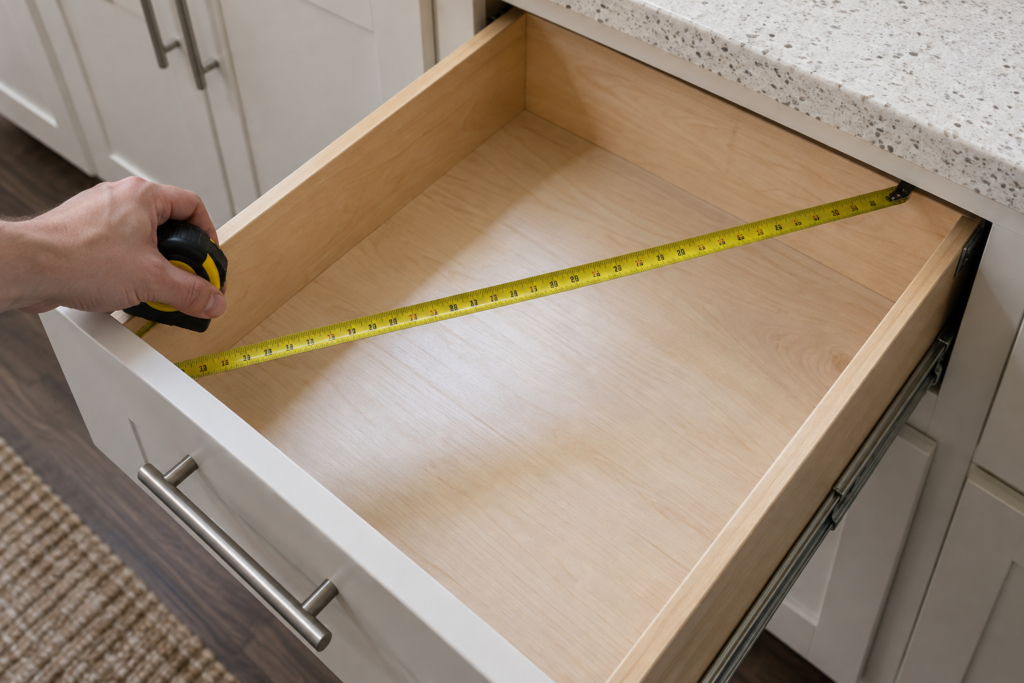
Check these measurements first:
- Interior width: Measure the narrowest point between the drawer sides.
- Interior depth: Measure from the inside front to the usable back wall.
- Usable height: Check whether tall utensils or stacked bins will clear the cabinet frame when the drawer closes.
- Runner clearance: Avoid placing rigid dividers where they interfere with drawer hardware.
- Handle clearance: Make sure tall items cannot tip forward and block the drawer front.
- Full-extension reach: Check whether the drawer opens far enough to access items stored at the back.
RenterRefine practical rule: If an organizer makes you lift one tray, move several tools, or pull out another bin just to reach an everyday item, the drawer is probably over-organized.
10 Small Kitchen Drawer Organization Ideas for Renters
1. Use an Expandable Cutlery Tray
An expandable tray can adapt to slightly different drawer widths and keep forks, spoons, knives, and small tools separated without permanent installation.
Expand it only as far as needed. A tray that fills every inch can leave no flexible space for unusual utensils. Measure the tray at both its minimum and maximum width before buying.
2. Add Adjustable Drawer Dividers
Spring-loaded or adjustable dividers can create custom sections for utensils, baking tools, reusable straws, clips, or small gadgets without screws or adhesive.
Use only enough tension to keep each divider stable. Excessive pressure is unnecessary and can mark thin drawer walls. Leave enough room for your hand to retrieve items rather than creating compartments that are too narrow to use comfortably.
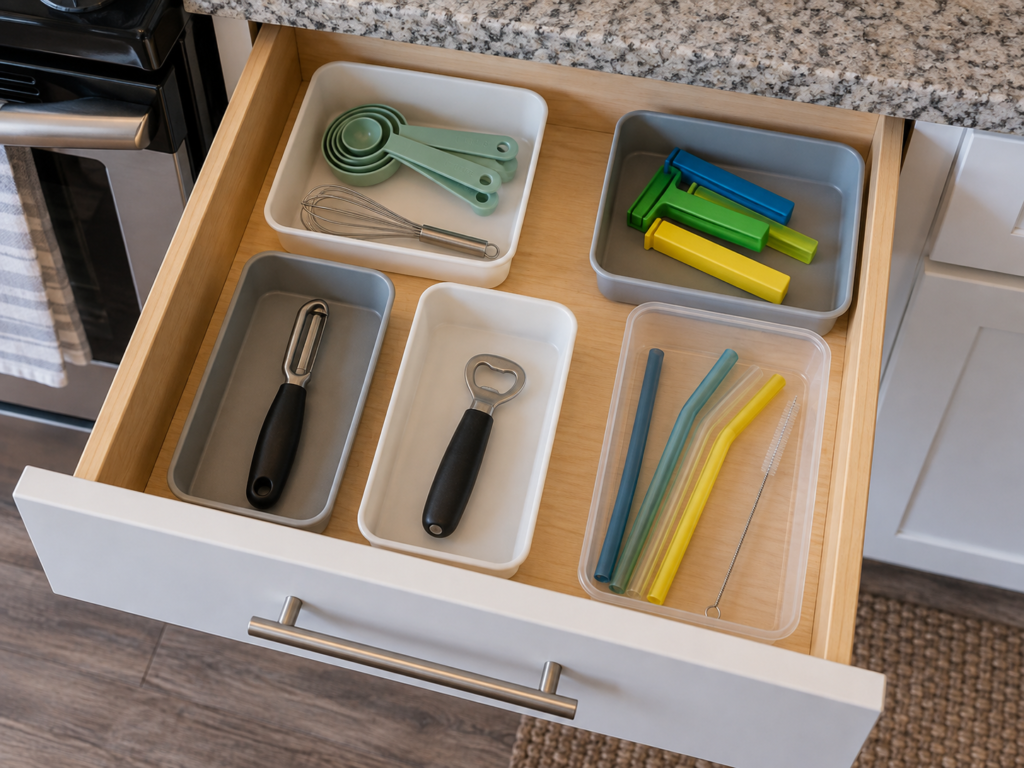
3. Use Small Open Bins for Loose Gadgets
Small bins work well for peelers, measuring spoons, clips, bottle openers, and other items that tend to scatter across a wide drawer.
Choose shallow bins that let you see the contents from above. Deep containers can hide small tools and turn the drawer into vertical clutter rather than useful storage.
4. Create a Dedicated Wrap and Bag Drawer
Foil, parchment, food-storage bags, and wraps can fit well in a dedicated drawer if the boxes lie flat without catching the frame.
Store only the formats you actually use and keep similar box sizes together. If long boxes prevent the drawer from closing cleanly, move them to an under-shelf basket or cabinet bin instead of forcing the fit.
5. Use a Drawer Spice Insert
An angled or flat spice insert can make labels easy to read from above and move a spice collection off the countertop.
Check drawer height carefully because spice jars that appear to fit may still hit the cabinet frame when the drawer closes. Our guide to no-drill spice rack ideas compares drawer inserts with magnetic, freestanding, and over-door options.
6. Use a Protective Knife Tray Rather Than a Loose Knife Drawer
If knives are stored in a drawer, use an organizer that keeps blades separated and covered rather than allowing sharp edges to move freely among other utensils.
In homes with children, secure access matters as much as organization. The U.S. Consumer Product Safety Commission recommends safety latches and locks on kitchen drawers and cabinets to help prevent children from reaching knives and other sharp objects. See CPSC childproofing guidance.
7. Add a Non-Adhesive Liner Under Loose Organizers
A removable non-adhesive liner can reduce sliding beneath small bins or trays and make the drawer easier to clean.
Use only enough material to cover the flat base. If the liner bunches, curls, or interferes with the runners, trim it rather than forcing it into the drawer.
8. Store Container Lids Vertically in a Deep Drawer
A deeper drawer can hold food-container lids vertically in a small freestanding rack or divided bin. Vertical storage can make matching a lid to a container much faster than stacking lids flat.
Sort by size and remove lids that no longer match any container. A lid organizer cannot compensate for keeping too many unmatched pieces.
9. Separate Everyday Tools From Occasional Gadgets
One of the most effective drawer improvements is simply separating high-frequency tools from things you use once a month. Keep everyday spatulas, tongs, peelers, and measuring tools in the easiest section to reach.
Move specialty gadgets into a secondary drawer, cabinet bin, or nearby shelf. This reduces search time without requiring a larger organizer.
10. Keep One Small Flex Zone
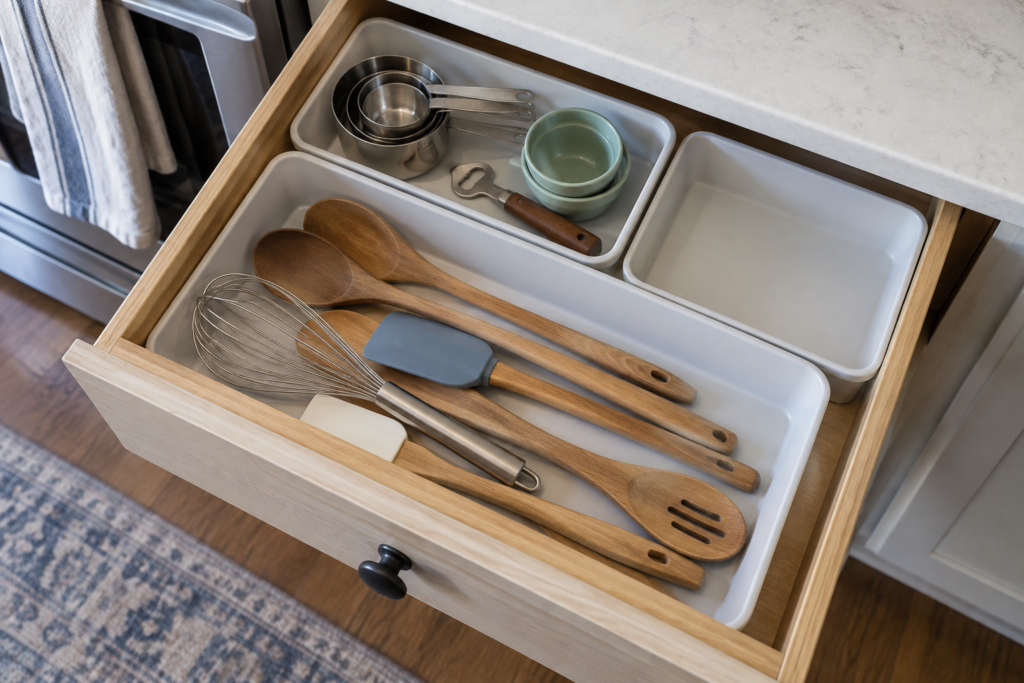
Not every square inch needs a permanent compartment. Leaving one small open section gives you somewhere to place an unusual tool, new item, or temporary kitchen accessory without reorganizing the whole drawer.
This flex zone also shows when the drawer is becoming overloaded. If the open area disappears under unrelated items, it is time to edit the contents rather than add another divider.
Which Drawer Organizer Fits the Problem?
| Organizer | Best For | Main Advantage | Main Fit Check |
|---|---|---|---|
| Expandable cutlery tray | Flatware and small utensils | Adjustable width | Interior width and height |
| Adjustable dividers | Custom utensil zones | Flexible compartments | Drawer-wall strength and spacing |
| Small open bins | Loose gadgets | Easy grouping | Bin height and visibility |
| Wrap drawer layout | Foil, parchment, bags | Flat storage | Box length and drawer depth |
| Spice insert | Spice jars | Readable labels | Jar height and closing clearance |
| Knife tray | Kitchen knives | Blade separation | Knife length and secure access |
| Lid rack | Container lids | Vertical visibility | Drawer depth and lid height |
| Non-adhesive liner | Loose trays and bins | Reduces sliding | Flat base and runner clearance |
Use the One-Motion Test for Everyday Drawer Items
A practical drawer should let you retrieve common items with one simple action after opening it. If you need to lift a tray, move another tool, or unpack a bin first, the layout may look neat but still be inefficient.
- One motion: everyday fork, spoon, spatula, peeler, or measuring tool.
- Two motions: occasional tools that can sit behind or beneath daily-use items.
- More than two motions: consider moving the item to secondary storage instead of keeping it in the prime drawer.
This test is useful because it judges the drawer by how it works during cooking rather than how organized it looks when photographed.
What Should Not Live in an Overcrowded Kitchen Drawer?
- duplicate tools you rarely use
- unmatched container lids
- large gadgets that block the drawer from closing
- loose sharp knives without protective storage
- heavy objects that strain a lightweight drawer
- backup supplies that would be easier to store in cabinets or freestanding storage
If your cabinets are also overloaded, our guide to kitchen cabinet storage without drilling covers risers, turntables, bins, drawers, and other removable options. For items that do not belong in cabinets or drawers, freestanding kitchen shelving can add portable overflow storage.
Common Kitchen Drawer Organization Mistakes
- Buying trays from drawer-front dimensions: Measure the interior box instead.
- Filling every compartment: Leave some flexibility for unusual items.
- Using deep bins for tiny tools: Small items disappear below the rim.
- Ignoring closing clearance: Tall jars or utensils can catch the cabinet frame.
- Keeping loose sharp knives: Use protective storage and secure access where children are present.
- Over-tightening tension dividers: Stability does not require excessive pressure.
- Organizing duplicates instead of removing them: Editing the contents usually creates more space than another organizer.
How to Organize a Small Kitchen Drawer Step by Step
- Empty the drawer completely.
- Group items by function and frequency of use.
- Remove duplicates, broken tools, and items that belong elsewhere.
- Measure interior width, depth, height, and closing clearance.
- Choose one organizer type that solves the main problem.
- Return everyday tools to the easiest-access section first.
- Add occasional tools only if the drawer still opens, closes, and retrieves cleanly.
- Use the drawer for one week and remove anything that repeatedly gets in the way.
For the broader kitchen-storage plan, see our main guide to kitchen storage without drilling. If countertop clutter is the bigger issue, see small kitchen countertop storage for renters.
Frequently Asked Questions
What is the best way to organize a small kitchen drawer?
Start by removing duplicates and measuring the usable interior. Then choose one main organizer—such as an expandable tray, adjustable dividers, or shallow bins—and keep the most frequently used tools easiest to reach.
Are adjustable drawer dividers renter-friendly?
Yes, removable spring-loaded or tension dividers can be renter-friendly because they do not require drilling. Use only enough pressure to keep them stable and check that they do not mark thin drawer walls.
How do I organize deep kitchen drawers?
Use shallow bins for small tools, vertical racks for lids, and clear zones for frequently used versus occasional items. Avoid deep containers that hide small objects below the rim.
Should knives be stored loose in a drawer?
No. Use a protective knife tray or another organizer that separates and covers blades. In homes with children, secure drawer access with an appropriate latch or lock.
How do I know if a drawer is over-organized?
If everyday items require several movements to retrieve, organizers have reduced usable access instead of improving it. The drawer should simplify common tasks rather than create additional steps.
Final Thoughts
Small kitchen drawer organization works best when the drawer is designed around use, not maximum capacity. Renters can improve access with expandable trays, removable dividers, bins, liners, spice inserts, knife trays, and simple zoning without permanently altering the cabinetry.
Measure the drawer, remove duplicates, keep everyday tools within one-motion reach, and leave a small amount of flexible space instead of filling every inch.
A well-organized drawer should open smoothly, close without catching, and help you find what you need faster than before.