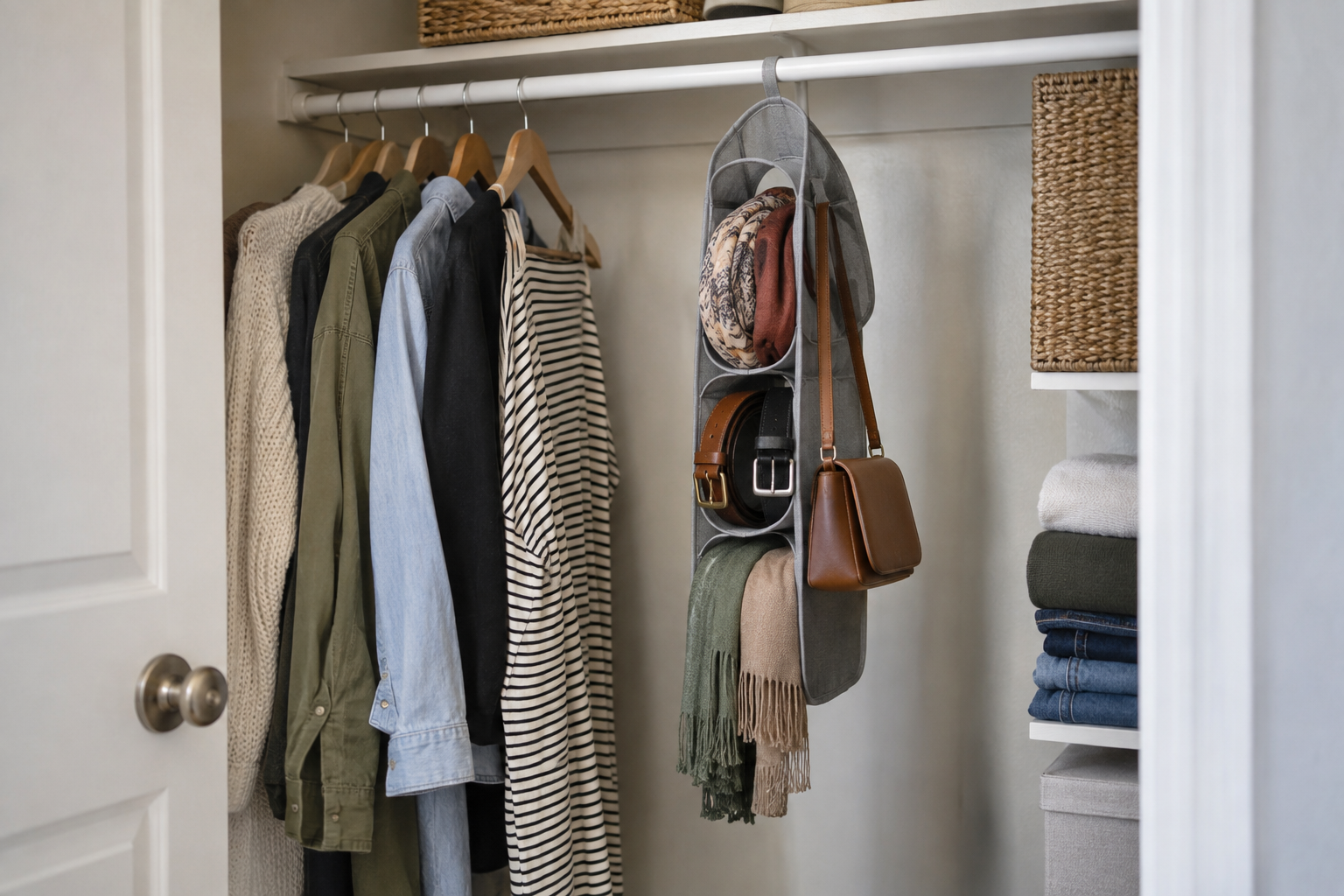
A hanging accessory organizer can turn a small section of closet rod into practical storage for belts, scarves, hats, small bags, ties, or other lightweight items without drilling. For renters, the best option is one that fits the available rod space, keeps accessories easy to see, and does not crowd the clothing already hanging beside it.
These organizers come in different forms, including loop hangers, fabric pocket organizers, multi-hook hangers, hanging rails, and compact tiered designs. The right choice depends less on how many items an organizer claims to hold and more on whether its width, drop length, attachment style, and everyday access suit the closet you actually use.
Why Hanging Accessory Storage Works Well in Small Rental Closets
Accessories are easy to scatter across drawers, shelves, hooks, and boxes because many of them are small and irregularly shaped. A hanging organizer groups those items in one vertical zone using the existing closet rod rather than taking up additional floor or shelf space.
That can be especially useful in a rental where permanent wall hooks or extra built-ins are not desirable. The tradeoff is rod space. Every hanging organizer occupies some of the same horizontal width used by clothing, so it should improve access enough to justify the space it takes.
What to Measure Before Buying a Hanging Accessory Organizer
Measure the closet while your usual clothing is still hanging. This gives you a more realistic picture of how much rod width and vertical clearance are actually available.
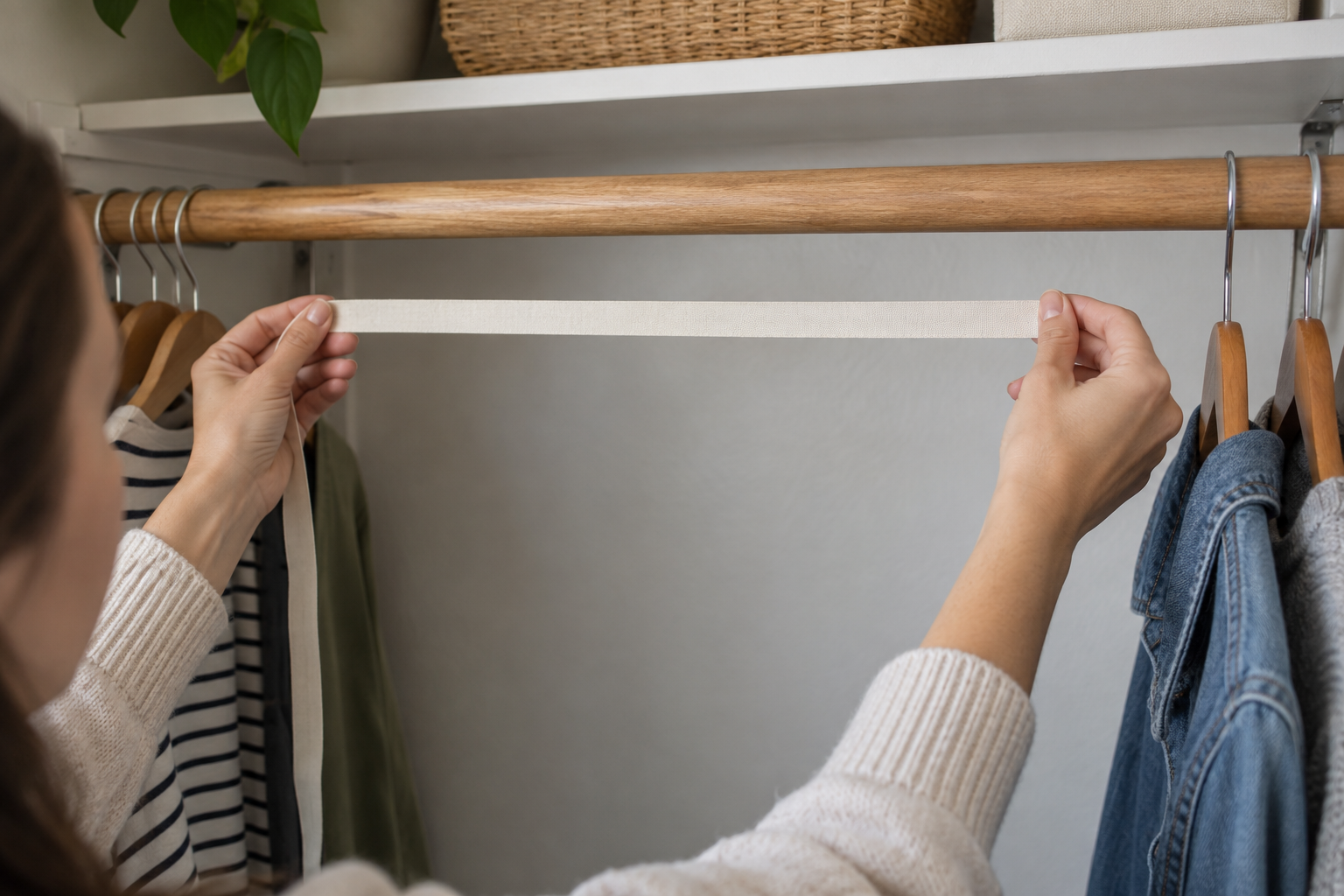
- Available rod width: Measure the horizontal space you can give the organizer without tightly compressing nearby garments.
- Drop length: Measure from the rod to the floor, shelf, drawer unit, or other storage below.
- Closet depth: Check whether the organizer will project too far toward the door.
- Rod diameter and shape: Confirm the attachment is compatible with the existing rod.
- Door clearance: Make sure sliding, bifold, or hinged doors can still operate normally.
- Item length: Measure long scarves, belts, or ties so they do not drag on the floor or storage below.
- Retrieval space: Leave enough room to remove one item without disturbing everything else.
- Existing storage below: Account for bins, drawers, shoes, or shelves in the same vertical zone.
Renter warning: A hanging organizer adds weight to the existing closet rod. Use it only for items that suit the organizer and rod, follow the exact product instructions, and avoid overloading a rod that is already heavily packed or visibly unstable.
7 Things to Check When Choosing a Hanging Accessory Organizer
1. The Type of Accessories You Need to Store
Start with the items, not the organizer. Belts and ties may work well on loops or bars, while scarves may need wider openings or smooth surfaces that reduce snagging. Small handbags may need pockets or short hooks, and hats may need more spacing so they are not crushed.
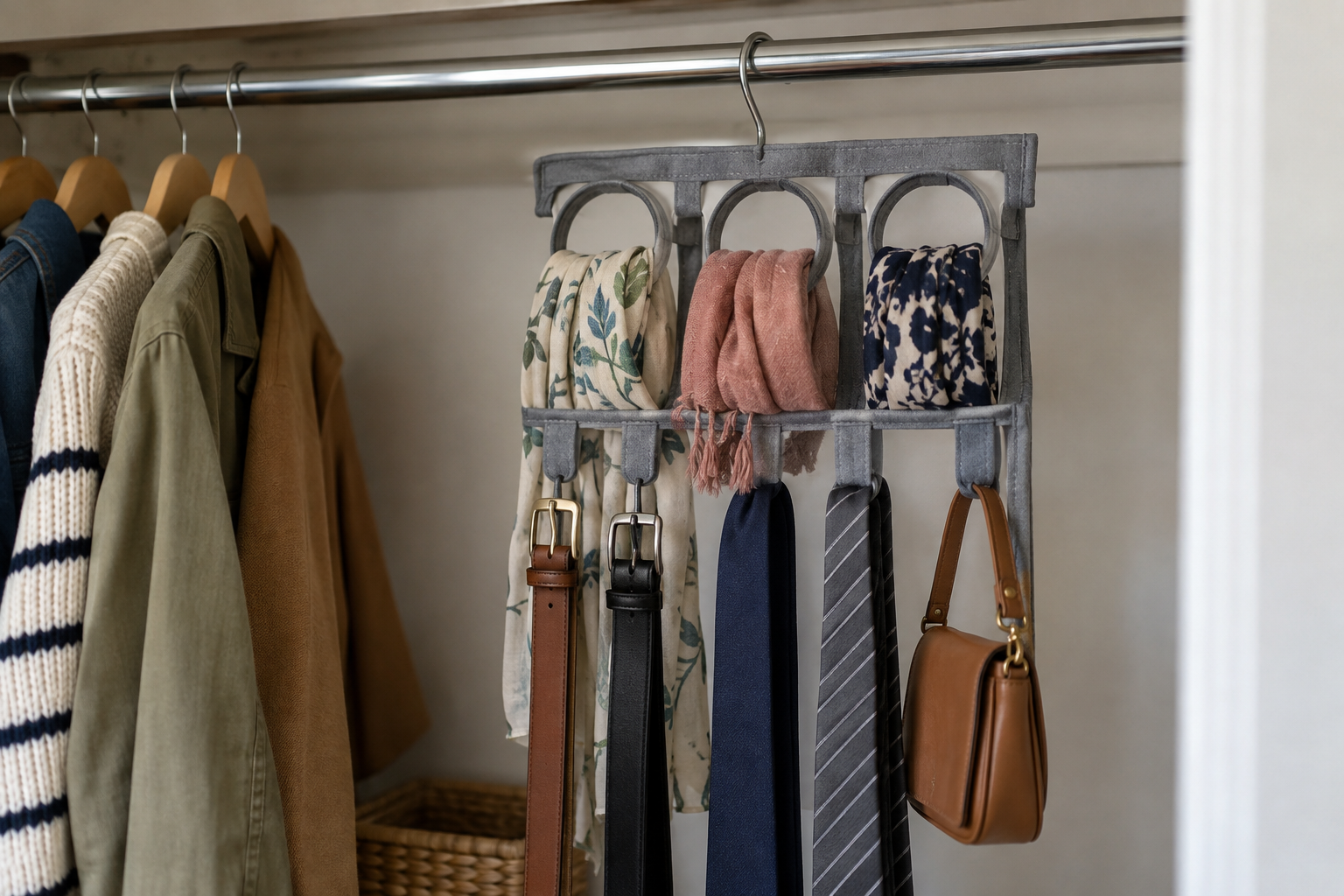
Choose a design that matches the category you use most often. An organizer with many small loops is not automatically useful if your accessories are bulky, and large pockets may waste space if most of your items are narrow.
2. Horizontal Rod Space
A hanging organizer can be narrow, but it still occupies valuable rod width. Measure how much space remains after your everyday clothing is hung comfortably. If installing the organizer forces shirts or jackets tightly together, you may simply be moving the storage problem from one category to another.
For a broader overview of renter-friendly options, our guide to closet storage without drilling compares hanging, floor, shelf, and door-based approaches.
3. Drop Length and Clearance Below
Measure the organizer’s full hanging length and compare it with whatever is underneath. A long accessory organizer can interfere with shoe racks, drawers, bins, or a freestanding closet shelf if both are using the same vertical space.
Leave enough clearance so the bottom of the organizer does not rest on stored items or prevent drawers from opening. If the closet already uses the floor area efficiently, a shorter design may be the better fit.
4. Attachment Style
Some organizers hang from a standard hanger-style hook, while others wrap, clip, or suspend from the rod in another way. Check the exact attachment design and make sure it fits the rod without forcing or modifying the existing closet hardware.
A rotating hook can improve access in some closets, while a fixed attachment may keep the organizer more stable. The useful choice depends on the closet depth, door opening, and how often you need to turn or move the organizer.
5. Visibility and Access
An accessory organizer is most useful when you can identify and remove items quickly. Open loops and hooks make contents visible, while pockets can contain smaller pieces but may hide what sits behind them. Clear or shallow pockets can help when visibility matters.
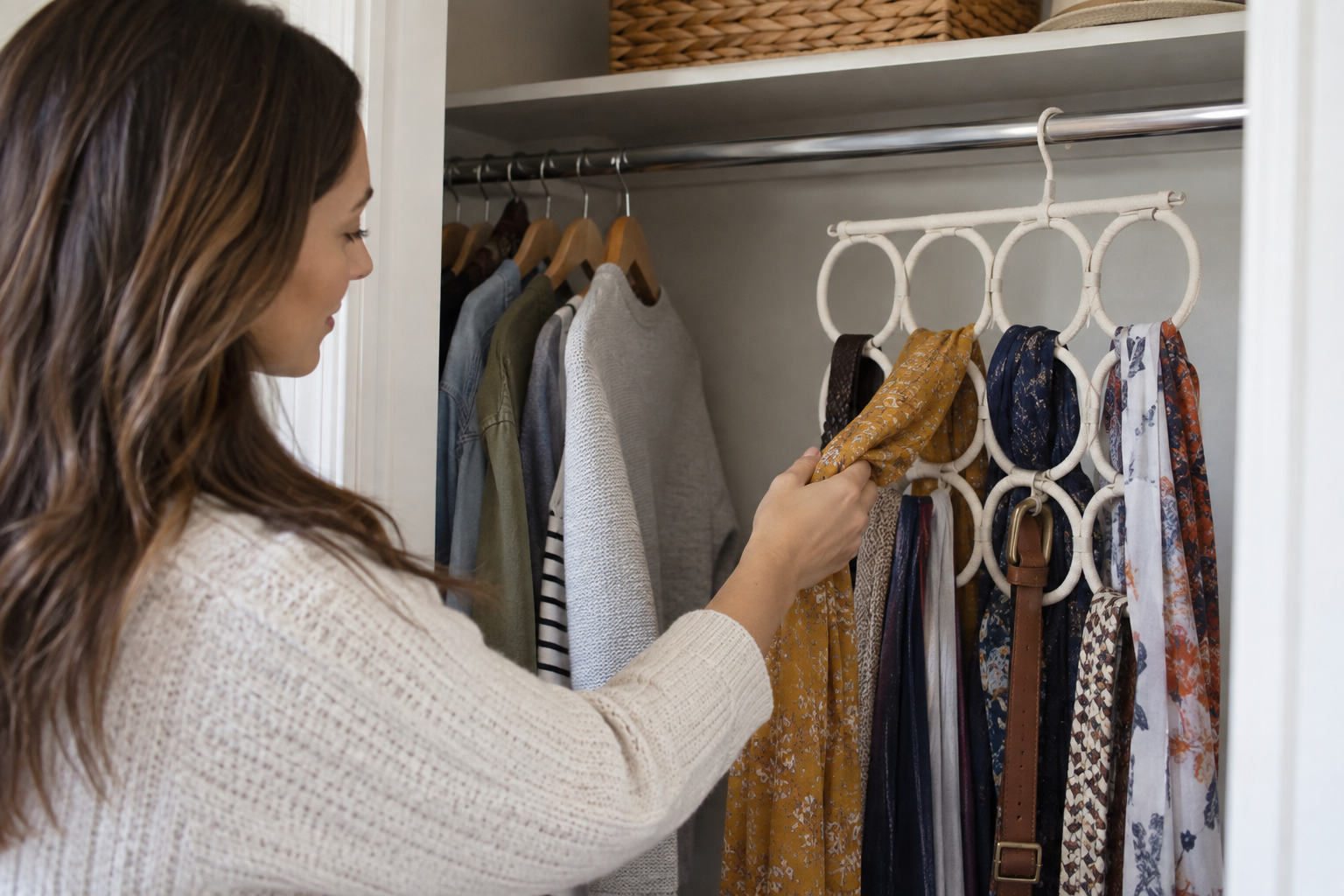
Think about how you retrieve items, not just how you load them. If reaching one belt requires removing three others, or if the organizer must be taken off the rod to access the back, the setup may become inconvenient over time.
6. Material and Contact Surfaces
Accessories can be damaged by rough edges, sharp hooks, tight clips, or unfinished hardware. Check the surfaces that will touch fabric, leather, coated buckles, jewelry pouches, or delicate items. Smooth contact areas are generally easier to use with soft accessories. For broader textile-care context, the Smithsonian Museum Conservation Institute notes that good storage should help protect textiles from abrasion and soiling.
Fabric organizers should also keep their shape well enough for the intended contents. If pockets collapse completely when partly filled, visibility and retrieval may become more difficult.
7. Weight and Rod Condition
The organizer itself may be light, but a collection of belts, bags, scarves, or accessories can add noticeable weight. Follow the organizer’s stated limits and consider the condition of the existing closet rod and supports before loading it. For general household-storage safety, the U.S. Consumer Product Safety Commission’s Anchor It! guidance is a useful reminder to follow manufacturer instructions and avoid unsafe loading or unstable storage setups.
If the rod already flexes, shifts, or appears heavily loaded, adding another hanging system may not be a good idea. A floor- or shelf-based solution may distribute storage more appropriately.
Which Hanging Accessory Organizer Style Fits Which Item?
Different organizer styles solve different problems. Use this as a practical starting point rather than a fixed rule.
| Organizer Style | Often Useful For | Main Advantage | What to Check |
|---|---|---|---|
| Loop hanger | Scarves, belts, ties | Compact vertical storage | Loop size and smoothness |
| Multi-hook hanger | Belts, small bags, caps | Quick visibility | Hook spacing and contact points |
| Pocket organizer | Small accessories | Contains loose items | Pocket depth and visibility |
| Tiered bar organizer | Ties, scarves, belts | Separates items by level | Drop length and retrieval |
| Hanging fabric cubbies | Folded accessories, hats, bags | Creates mini shelves | Width, sagging, rod space |
Hanging Accessory Organizer vs Over-the-Door Storage
A hanging accessory organizer uses the closet rod, which can work well when door clearance is limited or when you want accessories beside clothing. Its main cost is rod width.
Over-the-door closet storage uses the door instead of the rod and can free hanging space, but it must fit the door thickness, frame, hinges, and closing path. The better choice depends on which part of the closet has genuinely usable capacity.
Can You Hang an Accessory Organizer From a Tension Rod?
Only if the exact tension rod and organizer are intended for that use and the combined setup stays within their documented instructions. Do not assume that a rod used successfully for a few lightweight items can support a larger organizer once it is fully loaded.
If you are considering that type of setup, see our guide to tension rod closet storage before deciding whether the span, surfaces, and intended load are suitable.
How to Set Up a Hanging Accessory Organizer Step by Step
- Gather the accessories you actually want to store.
- Group them by type, size, and how often you use them.
- Measure available rod width and vertical clearance.
- Check the organizer’s attachment style and dimensions.
- Confirm nearby doors, shelves, and floor storage remain clear.
- Install the organizer according to its instructions.
- Load frequently used items where they are easiest to reach.
- Add remaining items gradually rather than filling every loop or pocket immediately.
- Check that the closet rod remains stable and clothing still slides normally.
- Remove or rearrange anything that makes access awkward.
Common Hanging Accessory Organizer Mistakes
- Buying an organizer before measuring available rod width.
- Ignoring the full drop length.
- Blocking drawers, bins, or shoe storage below.
- Choosing tiny loops for bulky scarves or wide belts.
- Using rough hooks with delicate accessories.
- Overfilling pockets until items become difficult to identify.
- Compressing nearby clothing to make the organizer fit.
- Adding too much weight to an already crowded closet rod.
- Assuming a tension rod can support a loaded organizer without checking its intended use.
Is a Hanging Accessory Organizer Renter-Friendly?
Yes, when it uses an existing suitable closet rod and can be removed without permanent changes. It is one of the simpler ways to add vertical organization for small accessories while keeping floor and shelf space available for other categories.
The main renter consideration is whether the organizer fits and can be used without overloading or interfering with the existing closet. Keep the setup light, reversible, and easy to remove when you move.
Frequently Asked Questions
What can I store in a hanging accessory organizer?
Depending on the design, it may suit belts, scarves, ties, hats, small bags, jewelry pouches, or other lightweight accessories.
How much closet rod space does one need?
That depends on the organizer’s width and the clothing beside it. Measure the available rod space rather than relying on an estimate.
Are hanging organizers good for scarves?
They can be. Look for smooth loops, bars, or openings that suit the scarf size and material without excessive bunching or snagging.
Can I use one for handbags?
Small lightweight bags may suit some organizers, but check the hook or pocket size, organizer instructions, and total loaded weight.
Do hanging accessory organizers require drilling?
Many attach to an existing closet rod without drilling, but check the exact product design and installation instructions before use.
Can a hanging organizer damage a closet rod?
Excessive weight or an unsuitable attachment can create problems. Follow the organizer instructions and avoid adding unnecessary load to a weak or unstable rod.
Is a pocket organizer better than hooks?
Pockets contain smaller loose items, while hooks provide quicker visibility for belts, scarves, or bags. The better option depends on what you store.
Can I hang an accessory organizer from a tension rod?
Only when the exact rod and organizer are suitable for the intended combined use. Check both sets of instructions rather than assuming compatibility.
Where should I position a hanging accessory organizer?
Place it where it does not crowd daily clothing, block the closet door, or interfere with storage below. Frequently used items should remain easy to reach.
Is a hanging accessory organizer useful in a very small closet?
It can be, especially when small accessories are taking up shelf or drawer space. The organizer should still leave enough rod width for your clothing.
Final Thoughts
A well-chosen hanging accessory organizer can make a small rental closet easier to use without permanent changes. Measure the available rod width and drop length, match the organizer style to the accessories you actually own, and keep everyday retrieval simple. The best setup is not the one with the most hooks or pockets—it is the one that keeps accessories visible without making the rest of the closet harder to use.