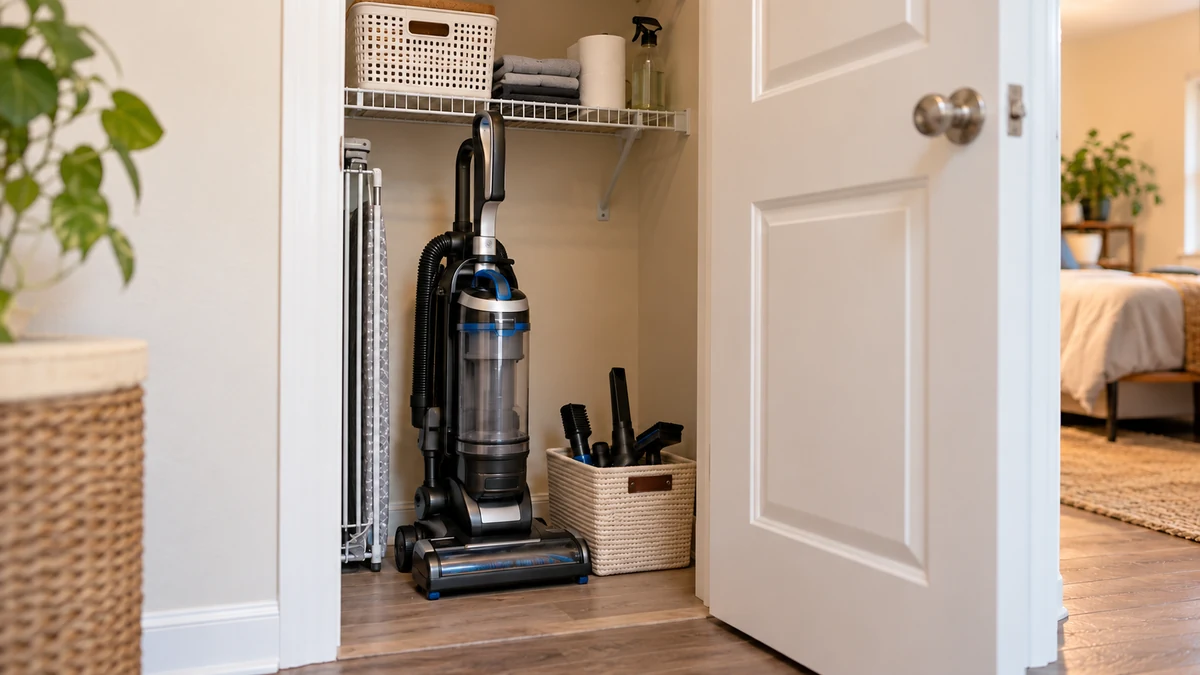
Vacuum cleaner storage ideas help small-apartment renters find a safe home for a bulky cleaning appliance without drilling holes or buying an oversized utility cabinet. A compact closet floor, a stable approved stand and a small accessory bin can make the difference between a clear entryway and a tripping hazard.
This guide covers 12 practical no-drill arrangements for upright, stick, canister and robot vacuums. Always follow the instructions for your specific model; the illustrative scenario is not a claim of hands-on product testing.
Measure a safe vacuum cleaner storage zone
 Save
Before buying a stand or basket, check the vacuum’s dimensions, weight, cord or charging requirements and the manufacturer’s instructions for storage. Test an existing closet or utility corner for a clear walking path and enough clearance to remove the vacuum without catching the handle on a shelf. The best vacuum cleaner storage ideas preserve easy access and keep the appliance stable.
A quick storage audit
- Measure height, width, depth and closet-door clearance.
- Confirm the vacuum’s approved storage orientation.
- Check whether the model needs a proprietary dock or charging mount.
- Plan dry storage for hoses, filters and accessories.
- Keep emergency exits and frequently used walkways clear.
12 vacuum cleaner storage ideas without drilling
1. Measure the vacuum and its parking spot
Measure the vacuum’s full height, floor footprint and closet-door clearance, including handles and hoses.
Practical limitation: Check manufacturer’s recommended orientation before planning upright storage.
2. Choose a stable low-floor parking position
Use an existing closet floor or accessible utility corner where the vacuum can stand securely.
Practical limitation: Avoid walkways, exits, vents and doors that need full swing clearance.
3. Use a shallow removable floor tray
A washable shallow tray helps organize the footprint and catch dry debris from wheels after cleaning.
Practical limitation: Do not store a vacuum with wet or leaking components.
4. Keep hoses loosely coiled
Follow the vacuum’s built-in storage guides or place detachable hoses in a large soft loop.
Practical limitation: Avoid kinking hoses or stressing connectors.
5. Contain attachments in a labeled bin
 Save
Collect crevice tools and upholstery heads in a small removable basket beside the vacuum.
Practical limitation: Do not let sharp attachments scratch floors or delicate surfaces.
6. Make a separate place for spare filters
Store clean dry spare filters in their original packaging according to manufacturer directions.
Practical limitation: Never put away a damp washable filter or reinstall it before fully dry.
7. Store a cordless vacuum without drilling
 Save
If freestanding storage is supported by the model, use an appropriate stable base or approved stand.
Practical limitation: Some cordless models require a manufacturer-specific mount or dock; do not improvise charging.
8. Keep cords contained without strain
For corded units, use integrated cord wraps or loose cable ties without tight bends.
Practical limitation: Unplug before storage and never pinch the cord in a door.
9. Use existing shelves for lightweight accessories
Reserve an established low or middle shelf for spare nozzles and manuals.
Practical limitation: Do not put heavy vacuums on high shelves.
10. Plan for robot vacuum clearance
Use an accessible floor position with the clearances and electrical setup specified by its manufacturer.
Practical limitation: Keep docks away from moisture and do not obstruct the robot’s route.
11. Separate cleaning chemicals from appliance storage
Keep liquids secure in original packaging and out of reach of children and pets.
Practical limitation: Avoid chemical leaks onto cords, chargers and filters.
12. Reset the vacuum zone after each use
Empty debris as instructed, inspect parts, dry cleaned components and return attachments to their containers.
Practical limitation: Do not store a hot, damaged or wet vacuum against fabrics.
Compare small-apartment vacuum storage options
| Vacuum type | Potential no-drill arrangement | Check first |
|---|---|---|
| Upright | Low closet floor parking | Stable standing position |
| Canister | Floor zone with loose hose loop | Hose and wheel clearance |
| Stick / cordless | Approved freestanding dock or stand | Model compatibility and charging |
| Robot vacuum | Accessible floor docking area | Required side and front clearance |
| Attachments | Removable basket on existing shelf | Dry and easy to reach |
Illustrative example: a one-bedroom rental
Imagine a renter who keeps a compact canister vacuum near the bedroom doorway and stores its attachments in different drawers. This is an illustrative scenario, not a firsthand apartment inspection. After measuring a hall closet, the renter assigns a stable floor area for the vacuum, loosely coils the hose according to instructions and places clean dry attachments in a removable low-shelf bin. The doorway stays unobstructed.
What improves: easier retrieval, less visible clutter and fewer misplaced attachments. What depends on the model: storage orientation, charging requirements and filter care.
A five-minute post-cleaning reset
- Switch off and unplug the vacuum or follow its charging procedure.
- Empty debris and maintain filters as directed.
- Let any washed removable components dry fully.
- Coil or secure the cord and hose without sharp bends.
- Return attachments and park the vacuum in its approved stable position.
Electrical safety, charging and renter precautions
Do not improvise wall mounting or charging stands for a model that requires a manufacturer-approved dock. Follow instructions for battery charging, cord routing and airflow. Keep the machine and charger away from water or leaking cleaning products. The U.S. Consumer Product Safety Commission’s electrical safety resources provide general home precautions; your vacuum’s manual remains the key source for model-specific rules. Never block an exit or place heavy appliances on unstable overhead shelves.
For another compact-apartment cleaning setup, see cleaning glove storage ideas. Check destination and publication status before publishing this draft.
Common storage mistakes
Leaning an unsupported stick vacuum against a wall: it can topple. Pinching cables in cabinet doors: cords can be damaged. Enclosing damp filters: moisture can cause problems. Blocking a hallway: this creates a trip hazard. Improvising battery charging: this can conflict with manufacturer safety guidance.
Frequently asked questions
Where should I store a vacuum in a small apartment?
Choose a dry, stable, low-level closet or utility area that does not block doors or traffic, provided the arrangement fits the model’s instructions.
Can I store a stick vacuum without drilling?
Some models support an approved freestanding stand or dock. Check compatibility; do not rely on an unsupported leaning position.
How should I organize vacuum attachments?
Use a removable basket or compartment on an existing shelf, and return clean dry attachments to the same location after use.
Can a robot vacuum go under furniture?
Only when its manufacturer-specified access, airflow and charging clearances can be maintained.
Final takeaway
Good vacuum cleaner storage ideas balance footprint, accessibility and electrical safety. Measure the space, follow the appliance manual and choose stable, reversible organizing methods that work in a rental.