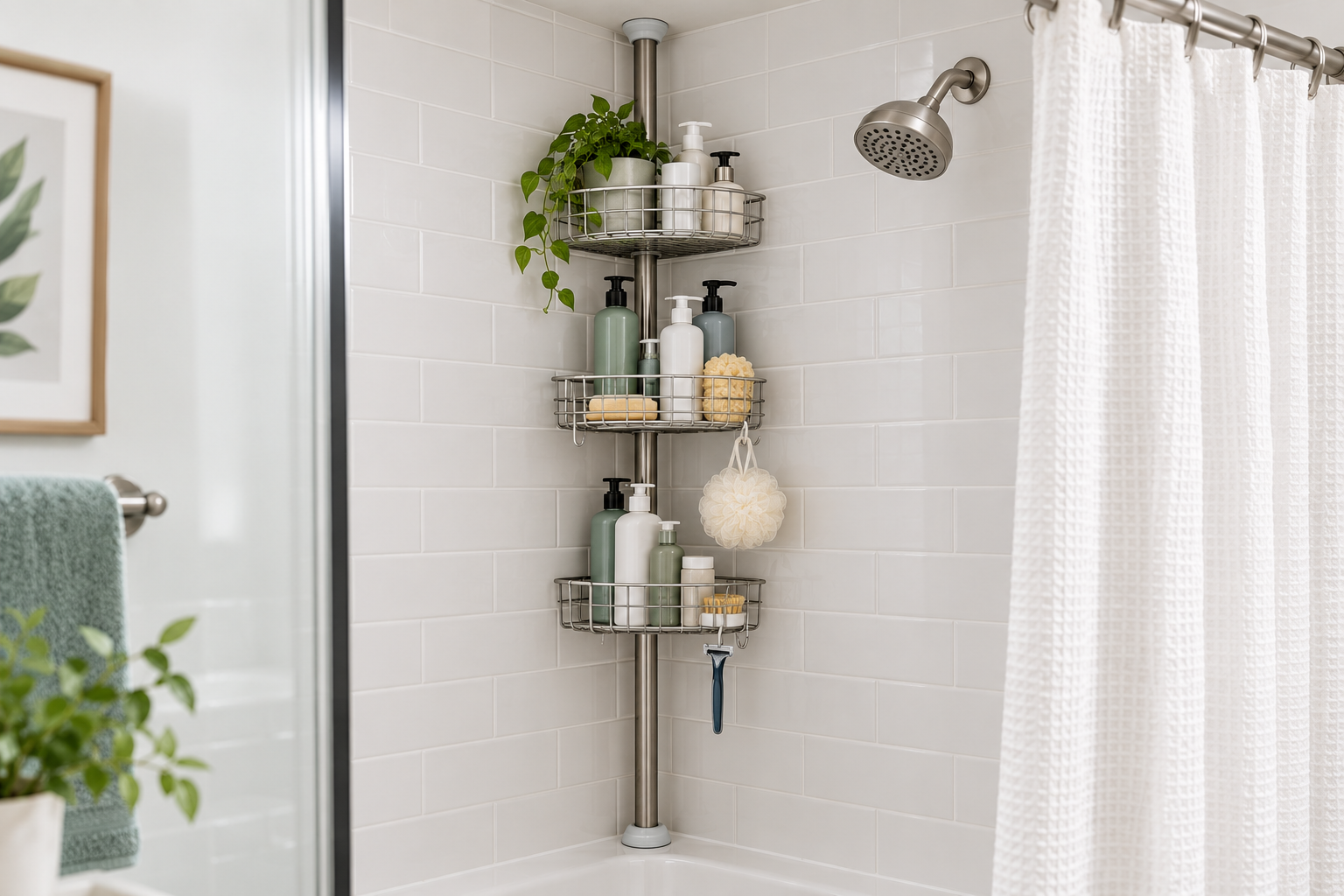
A tension shower caddy can add useful vertical storage without drilling into a bathroom wall. It may be especially helpful in a rental with a crowded tub ledge, limited cabinet space, or no built-in shower shelves.
A good fit depends on more than the pole’s advertised height. The ceiling, floor or tub contact point, available corner space, installation pressure, organizer design, and loaded weight all affect stability and suitability.
Before choosing a tension shower caddy for renters, measure the installation area and inspect both contact surfaces. The right caddy should hold the items you actually use, drain easily, and come down without requiring alterations to the bathroom.
Is a Tension Shower Caddy Good for Renters?
A tension caddy can be a practical choice when the rental agreement restricts drilling or permanent wall attachments. Most designs use a spring, adjustable pole, or locking mechanism to create pressure between two opposing surfaces.
Because the caddy stands vertically, it can provide several storage levels within a relatively small footprint. Adjustable shelves may also accommodate a mix of tall bottles, soap, razors, and washcloths.
However, a no-drill shower caddy is not automatically damage-free. Too much pressure may mark or stress a ceiling, tub ledge, or shower floor. Too little pressure may allow the pole to lean or slip.
A tension caddy may also be unsuitable for a flexible ceiling panel, damaged finish, sloped surface, or other contact point excluded by the manufacturer. Check your lease and the product instructions before installation.
How a Tension Shower Caddy Works
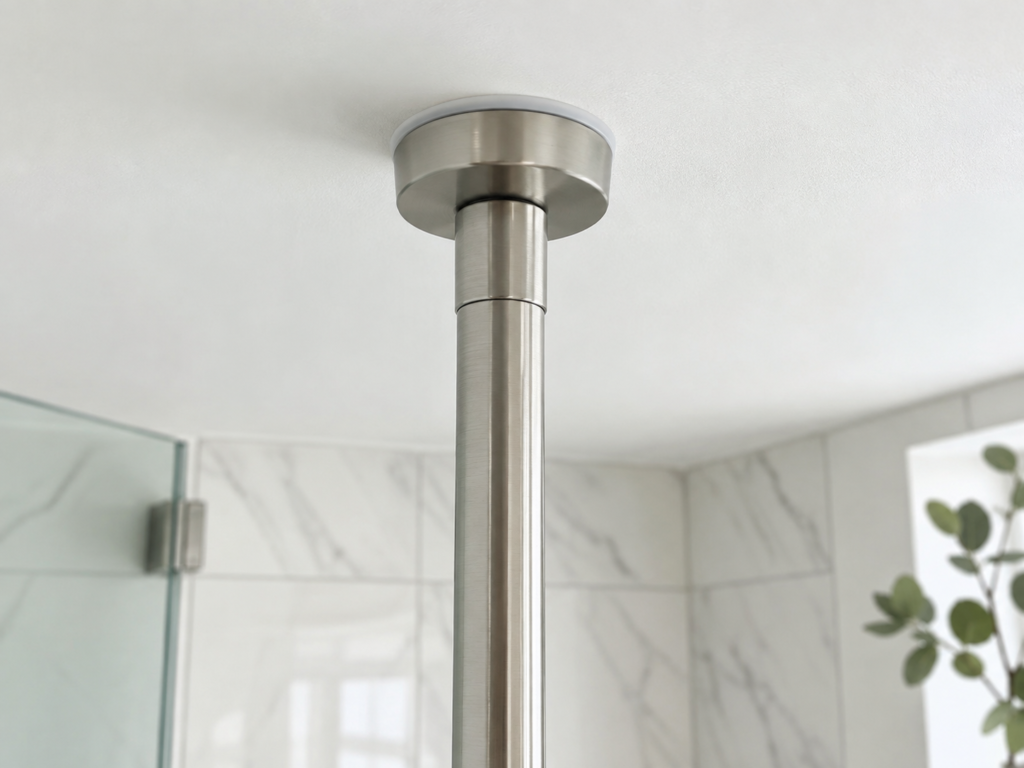
A tension pole shower caddy extends between a lower contact point and the ceiling. Depending on the design, a spring, threaded section, telescoping pole, or locking mechanism provides the pressure that keeps it upright.
 Save
SaveThe feet or end caps spread that pressure over the contact areas and may include a grippy material to reduce movement. Shelves attach at different heights along the pole.
Designs vary considerably. For example, OXO’s Lift & Lock instructions use a foot lever to lock the pole, while other models use different extension and adjustment systems. Follow the directions for the exact caddy you own rather than applying instructions from a similar-looking product. OXO Lift & Lock installation instructions
The pole should stand straight and remain stable under the permitted load. The shelves should not interfere with the showerhead, curtain, door, controls, or the person using the shower.
What to Measure Before Buying One
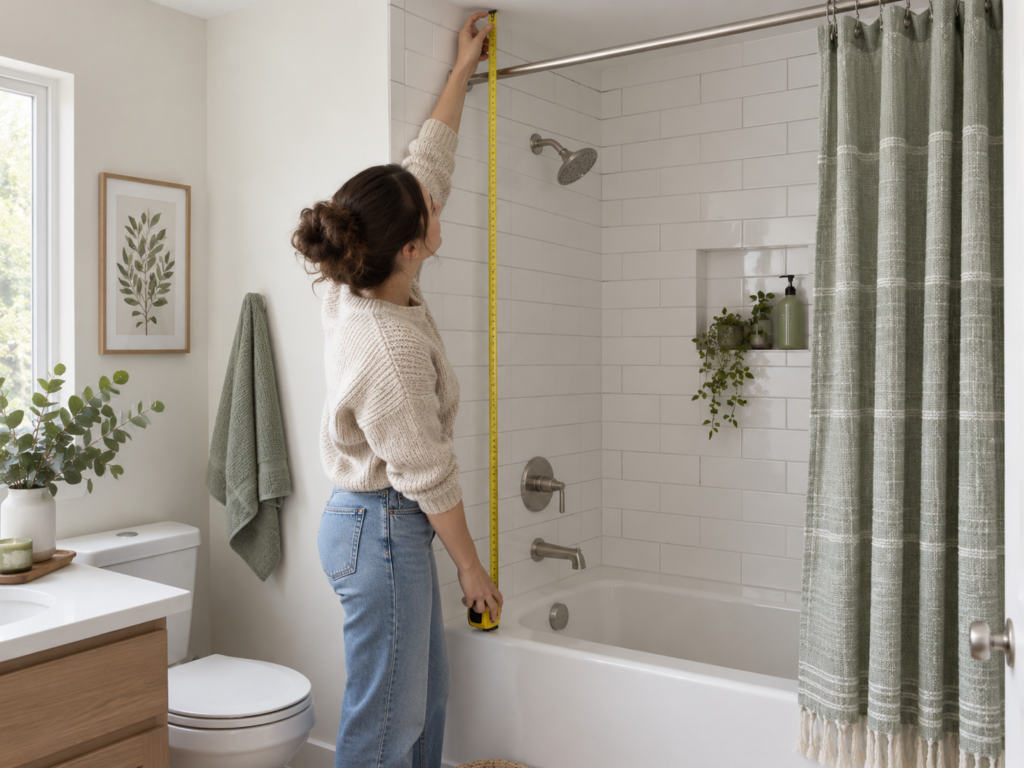
Take measurements at the exact corner or location where you plan to install the caddy. Shower surrounds, tub ledges, and ceilings may not be perfectly level, so a measurement from another part of the bathroom may be misleading.
 Save
SaveFloor-to-ceiling or tub-to-ceiling height
Measure vertically between the two intended contact points. If the pole will stand on a tub ledge, measure from that ledge—not from the bathroom floor.
Compare the measurement with the manufacturer’s stated height range and required configuration. Don’t assume an extension piece can be removed, added, or cut unless the instructions say so.
Usable corner width
Measure how much wall space is available on both sides of the corner. Account for grout lines, trim, built-in soap dishes, grab bars, and other projections.
Compare that space with the full shelf dimensions. A pole might fit vertically while its baskets collide with a wall feature.
Ceiling condition
Inspect the intended upper contact point for cracks, peeling paint, water damage, uneven texture, or movement. Avoid fragile, loose, flexible, or otherwise unsuitable ceiling surfaces.
If the ceiling condition is uncertain, ask the property manager before applying pressure to it.
Floor or tub contact point
The lower foot needs a stable position where it can sit as the manufacturer intends. Check for slopes, curves, seams, raised texture, and flexible panels.
A narrow tub rim may not provide enough room for a large foot. Don’t balance the pole partly over an edge or against plumbing.
Showerhead clearance
Measure the distance from the corner to the shower arm, showerhead, hose, and controls. Make sure you can adjust or remove the showerhead normally.
Allow room for the spray pattern, too. Constant direct spray may increase deposits and maintenance even when the caddy material is designed for a wet environment.
Shelf depth
Measure how far each shelf will project into the shower. Deep shelves provide more capacity but can reduce elbow room in a compact enclosure.
Consider the shelf’s complete shape rather than relying on one dimension. Corner baskets may be widest at the front.
Bottle height
Measure your tallest everyday bottle, including its cap or pump. Leave enough space above it to lift it off the shelf.
Adjustable shelves can help, but their usable positions may be limited by pole joints or mounting hardware. Simplehuman, for example, describes adjustable shelves that slide to accommodate taller bottles on its tension caddy; that feature and its limits are specific to the model. Simplehuman tension shower caddy information
Shower-door or curtain clearance
Open and close the shower door through its complete path. Check whether a door panel, hinge, or handle enters the proposed storage area.
For a curtain, leave room to pull it fully closed without catching it on baskets or bottles. Also preserve a comfortable entrance into the shower.
Tension Shower Caddy for Renters: 8 Things to Check
1. Height Range
The caddy’s supported height range must include your measured installation height. Check whether that range changes according to the number of pole sections used.
A model that barely reaches may not provide the intended engagement between sections. One that must be compressed far beyond the instructions may place excessive pressure on the contact points.
Use only the components and configuration approved by the manufacturer.
2. Stability
Look for a design that provides secure upper and lower contact, a rigid pole, and shelves that attach without excessive movement. Read the instructions to understand how the caddy locks and how stability should be checked.
Stability also depends on installation. The pole should be vertical, the contact points should be suitable, and the mechanism should be fully engaged as directed.
A shower caddy is storage, not a grab bar. Never use it for balance or body support.
3. Shelf Capacity
Count the products you use in the shower rather than buying for every possible item. A few well-spaced shelves may be more useful than many small baskets.
Check shelf dimensions, bottle openings, hooks, and any stated load limits. Make sure bars or openings are shaped so your containers will not tip through them.
Keep breakable containers out of positions where a fall could cause injury.
4. Weight Distribution
Full bottles are heavier than they look, especially when several are grouped on one shelf. Follow the manufacturer’s total and per-shelf limits when provided.
Spread heavier products across lower shelves and keep the load balanced around the pole. Avoid placing all large bottles on the same side.
If the pole begins leaning, rotating, or sliding after loading, unload it immediately. Don’t respond by overtightening it beyond the installation instructions.
5. Moisture and Drainage
Choose shelves that allow water to drain rather than pool beneath bottles or soap. Open wire or slotted designs can improve drainage, although they still require cleaning.
Check whether removable trays or baskets can be taken out without dismantling the entire pole. Easier access makes it more practical to remove soap residue and mineral buildup.
Leave space around bottles so air can circulate and surfaces can dry.
 Save
Save6. Rust Resistance
Bathrooms expose storage to moisture, cleaning products, and repeated wetting. Check the stated materials and care guidance instead of assuming every metallic finish offers the same protection.
Some manufacturers describe specific models as rust-proof or rust-resistant. Simplehuman, for example, identifies stainless steel and anodized aluminum in its tension caddy materials. That statement supports the specifications of that product, not all tension caddies.
Even suitable materials need maintenance. Clean the caddy according to its instructions, rinse away residue where appropriate, and watch joints or damaged coatings for deterioration.
7. Installation and Adjustment
Review the installation instructions before buying if they are available. Consider the number of pole sections, how shelves attach, and whether one person can safely control the pole during setup.
Choose a design that lets you adjust shelves without repeatedly removing the entire unit. Shelf positions should work for your bottles while keeping controls and plumbing accessible.
Never substitute extra force for an incompatible height or unstable contact point.
8. Removal and Rental Damage Risk
Check how the tension releases and whether shelves should be removed first. A controlled release is easier to manage than a pole that springs loose unexpectedly.
Before removal, empty every shelf and dry the surrounding area. Support the pole while releasing its mechanism, following the manufacturer’s sequence.
Inspect the upper and lower contact points afterward. Pressure, trapped moisture, grit, or repeated movement may leave marks even when no drilling was involved.
Where to Position a Tension Shower Caddy
A back corner is often useful because it keeps storage away from the entrance. But the best position is the one that offers compatible contact surfaces, enough basket clearance, and safe access.
Place frequently used bottles between roughly waist and shoulder height when possible. This reduces reaching and keeps heavier items away from the top of the pole.
Keep the caddy clear of shower controls, drains, grab bars, and any access panels. Don’t place it where a slipped bottle could strike a person or block the exit.
Avoid positioning shelves directly in the strongest part of the spray unless the setup requires it. Less direct water can mean less standing water and residue.
Once installed, step into the shower and move normally before loading the caddy. Confirm that the baskets do not create an awkward obstruction.
When a Tension Caddy Is Better Than Adhesive or Suction Shelves
A tension caddy may be preferable when wall surfaces are textured, interrupted by grout, or otherwise incompatible with a particular adhesive or suction product. It can also provide multiple shelves from one vertical installation.
The options involve different tradeoffs:
| Consideration | Tension caddy | Adhesive shelves | Suction shelves |
|---|---|---|---|
| Mounting method | Pressure between upper and lower contact points | Adhesive mounting system | Vacuum seal or mechanical suction system |
| Surface dependence | Depends on suitable opposing contact points | Depends on manufacturer-approved wall surfaces | Commonly requires smooth, nonporous surfaces |
| Adjustability | Shelves may be vertically adjustable | Position is usually fixed after mounting | May be repositionable after release |
| Maintenance | Clean shelves, pole, joints, and contact points | Clean shelves and inspect adhesive attachment | Clean shelves and inspect or reapply suction as directed |
| Removal | Release tension according to instructions | Follow the adhesive’s specified removal process | Release suction according to instructions |
| Renter damage concerns | Pressure marks, surface stress, trapped moisture, or slipping | Finish lifting, residue, or attachment failure | Marks, slipping, or falling items |
| Best use case | Several storage levels in a suitable vertical space | Fixed shelf position on an approved surface | Lighter storage on a compatible smooth surface |
A separate guide to adhesive vs suction shower shelves can help when your ceiling or lower contact point is unsuitable for tension storage.
If you’re considering the full range of bathroom storage without drilling, compare how each option interacts with your rental’s surfaces before choosing.
When a Tension Shower Caddy Is Not a Good Choice
Choose another storage method when:
- The measured height falls outside the product’s supported range.
- The ceiling is sloped, damaged, flexible, or otherwise unsuitable.
- The tub ledge, shower floor, or other lower contact point is too narrow, curved, unstable, or excluded by the manufacturer.
- Shelves would obstruct the showerhead, controls, door, curtain, grab bars, or safe entry.
- The bathroom cannot accommodate the shelf depth comfortably.
- You need to store more weight than the caddy is designed to hold.
- The lease or property manager prohibits the installation method.
- The pole will not remain stable when installed exactly as directed.
A hanging shower caddy, suitable adhesive or suction storage, or an organizer outside the wet area may work better. Don’t alter bathroom surfaces or omit required product components to make a tension caddy fit.
How to Reduce the Risk of Marks or Damage
Before installation, photograph the ceiling and lower contact point. Record existing stains, cracks, peeling finishes, or other defects.
Then take these precautions:
- Confirm that both contact points are suitable. Check the product instructions and ask the property manager when the surface condition or construction is unclear.
- Clean as directed. Remove grit and residue using methods compatible with both the surface and the caddy.
- Assemble the correct configuration. Use the specified pole sections, feet, and locking components.
- Install the pole vertically. A leaning pole can place uneven pressure on its contact points.
- Apply only the instructed pressure. Stop if the surface flexes, marks, cracks, or makes concerning sounds.
- Test it empty first. Check stability without hanging or pulling on the shelves.
- Load it gradually. Balance the contents and remain within all stated limits.
- Inspect it regularly. Watch for slipping, corrosion, loosened parts, trapped moisture, or new marks.
- Unload it before adjustment or removal. Support the pole and release tension according to its instructions.
Do not overtighten a slipping pole. Slipping may indicate incorrect assembly, an unsuitable surface, an incompatible height, contamination at a contact point, excessive load, or worn components. Remove the caddy and identify the cause.
Frequently Asked Questions
Can a tension shower caddy damage the ceiling?
It can leave marks or cause damage if the ceiling is fragile, damaged, unsuitable for pressure, or exposed to excessive installation force. Dirt or trapped moisture at the upper foot may also affect the finish. Check the ceiling condition and product instructions before installation, and never overtighten the pole.
Why does my tension shower caddy keep slipping?
Possible causes include an incorrect height configuration, insufficient installation pressure, a pole that isn’t vertical, unsuitable contact surfaces, excess weight, uneven loading, residue, or worn parts.
Unload and remove the caddy before troubleshooting. Recheck the measurements, assembly, contact points, and manufacturer guidance rather than simply applying more pressure.
How tight should a tension shower caddy be?
It should be installed to the level described by its manufacturer and no tighter. Different products use different springs, threads, levers, and locking mechanisms, so there is no universal number of turns or amount of force.
The pole should stand securely under its permitted load without deforming or marking the contact surfaces.
Can you use a tension caddy in a fiberglass shower?
Only if the manufacturer states that the product is compatible with the specific contact surfaces and those surfaces can safely accept the required pressure. Fiberglass and other shower components can flex, and construction varies.
Do not assume compatibility based only on appearance. Check the shower documentation when available and ask the property manager if the construction is uncertain.
Is a tension shower caddy better than adhesive shelves?
It depends on the bathroom. A tension caddy can provide more vertical storage and does not rely on adhesive bonding to a wall. Adhesive shelves may use less space and avoid placing pressure between the ceiling and tub or floor.
Choose according to surface compatibility, available space, load, maintenance, removal requirements, and the manufacturer’s instructions.
Final Thoughts
A useful tension shower caddy starts with accurate measurements and suitable contact points. Check the full installation height, ceiling condition, lower support, shelf clearance, and the bottles you plan to store.
Follow the instructions for the exact product, load it gradually, and inspect it regularly. If it slips or creates marks, remove it and find the cause instead of overtightening the pole.
The best choice is one that adds practical storage while preserving safe shower access and respecting the surfaces and rules of your rental.