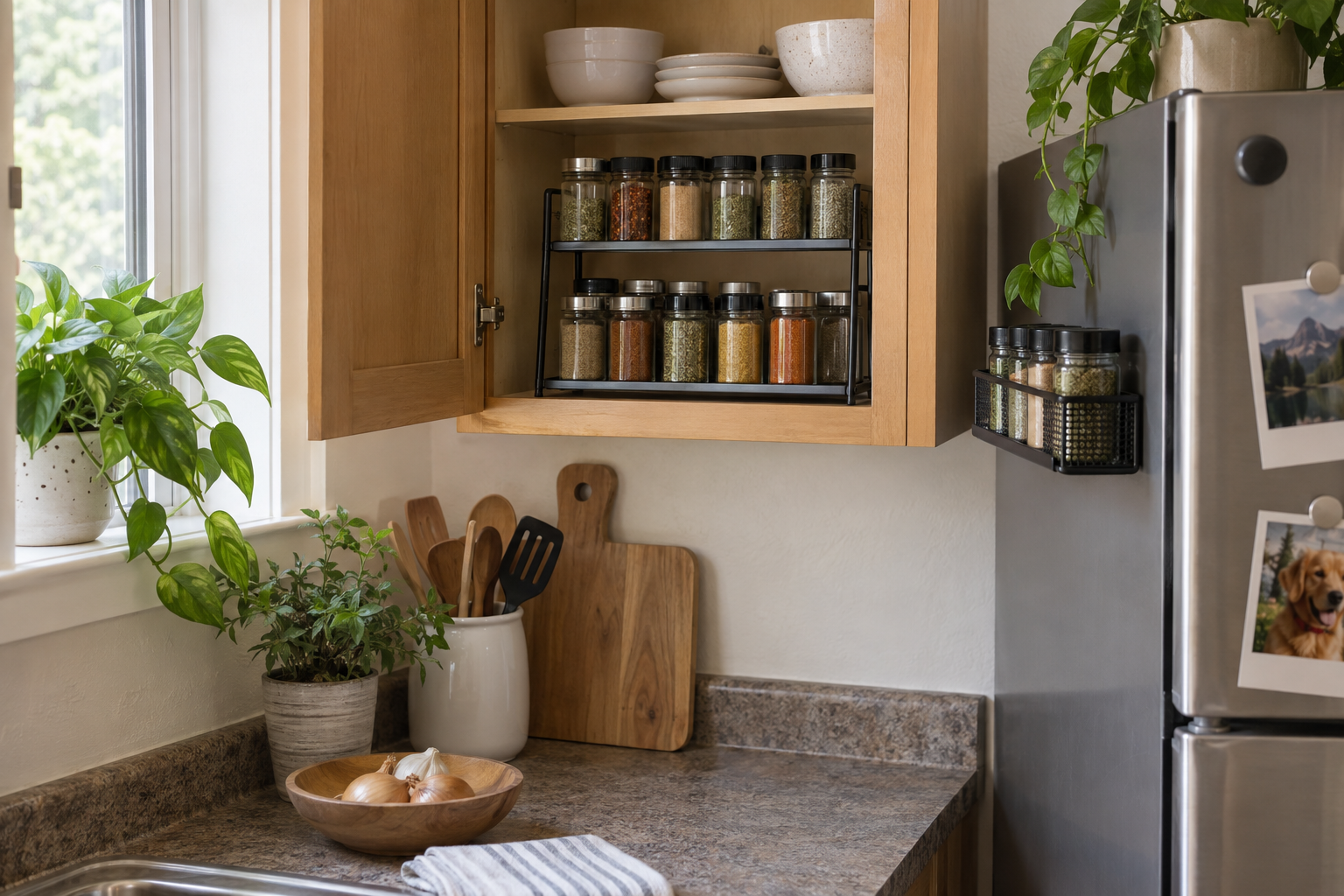
No-drill spice rack ideas can help renters organize jars without putting holes in walls, backsplashes, or cabinet doors. The best option depends less on how many jars you own and more on where you have usable space: inside a cabinet, on a refrigerator side, in a drawer, on a pantry door, or on the countertop.
Before buying a rack, measure the jars as well as the storage area. Spice containers vary in height and diameter, and a rack that looks compact online can still block a cabinet door, interfere with a shelf, or make labels difficult to see.
This guide covers 10 renter-friendly ways to store spices without drilling, including options that avoid adhesives entirely and others that use removable mounting methods where the surface and lease allow them.
Before Choosing a No-Drill Spice Rack, Measure the Space and the Jars
A spice organizer needs to fit both the storage zone and the containers. Start by choosing where the spices should live, then measure that location before comparing products.
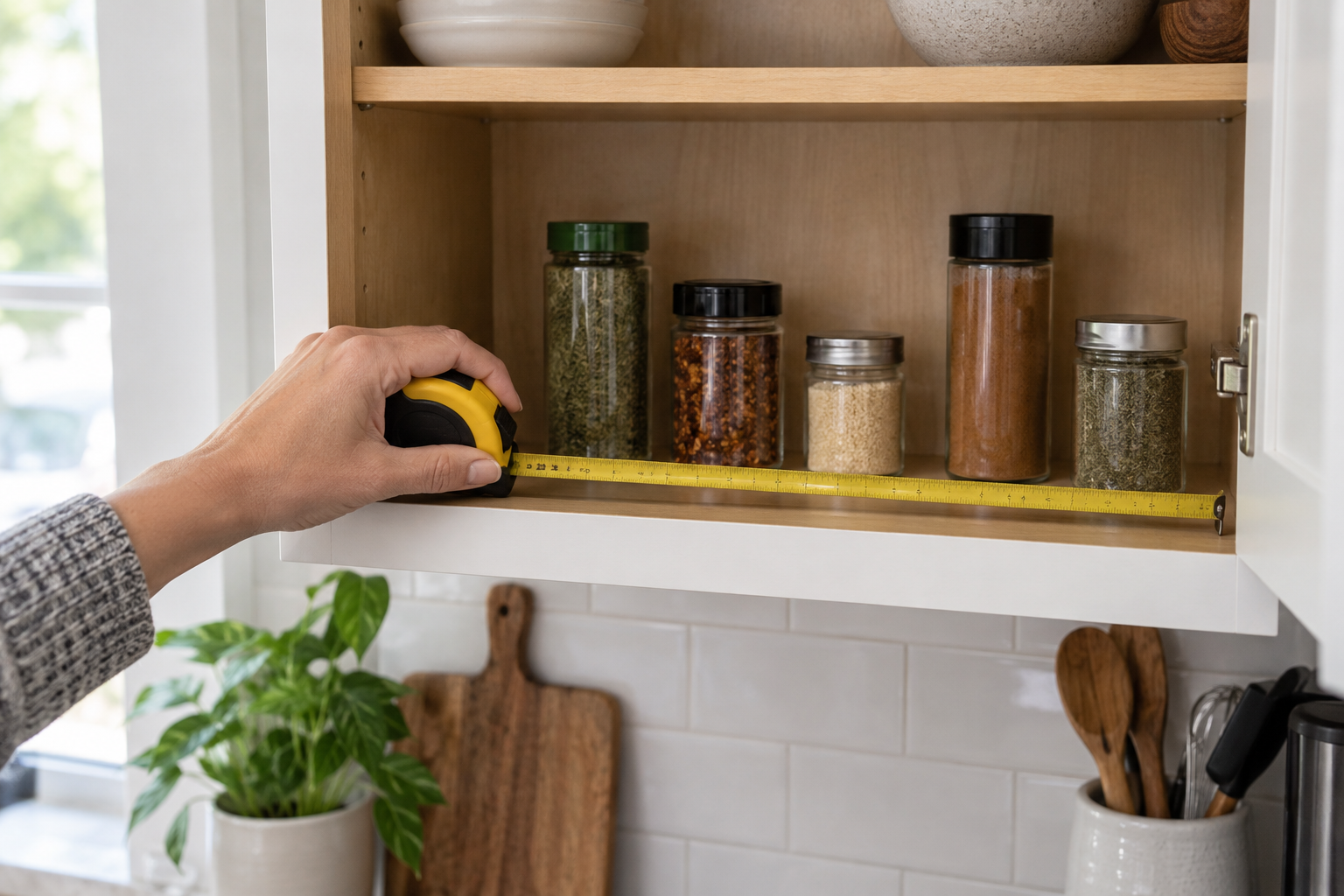
Check these dimensions first:
- Jar height: Measure the tallest spice container you regularly use.
- Jar diameter: Check whether wider jars fit comfortably without forcing neighboring containers sideways.
- Available width: Measure the cabinet shelf, drawer, refrigerator side, pantry door, or counter area.
- Available depth: Confirm that the rack will not prevent a cabinet or pantry door from closing.
- Vertical clearance: Measure the space above the jars if you are considering a tiered shelf, under-shelf rack, or stacked organizer.
Renter tip: Start with the least permanent method that solves the problem. Freestanding, drawer, magnetic, and over-door organizers can often be removed without touching a painted or finished surface.
10 No-Drill Spice Rack Ideas for Renters
1. Use a Freestanding Tiered Spice Shelf Inside a Cabinet
A small tiered shelf is one of the simplest no-drill options because it sits directly on an existing cabinet shelf. The stepped levels make back-row jars easier to see without permanently changing the cabinet.
This works best when the cabinet has enough vertical clearance above the tallest jars. Measure the shelf depth too, because a deep tiered rack can push jars close to the cabinet door.
2. Add a Spice Drawer Insert
If you have a shallow kitchen drawer available, an angled or flat spice insert can keep jars visible from above and eliminate the need for wall or door mounting.
Measure drawer height carefully. A jar that fits while lying at an angle may still catch the drawer frame when you close it. Drawer storage is especially useful for renters who want a completely removable solution with no adhesive.
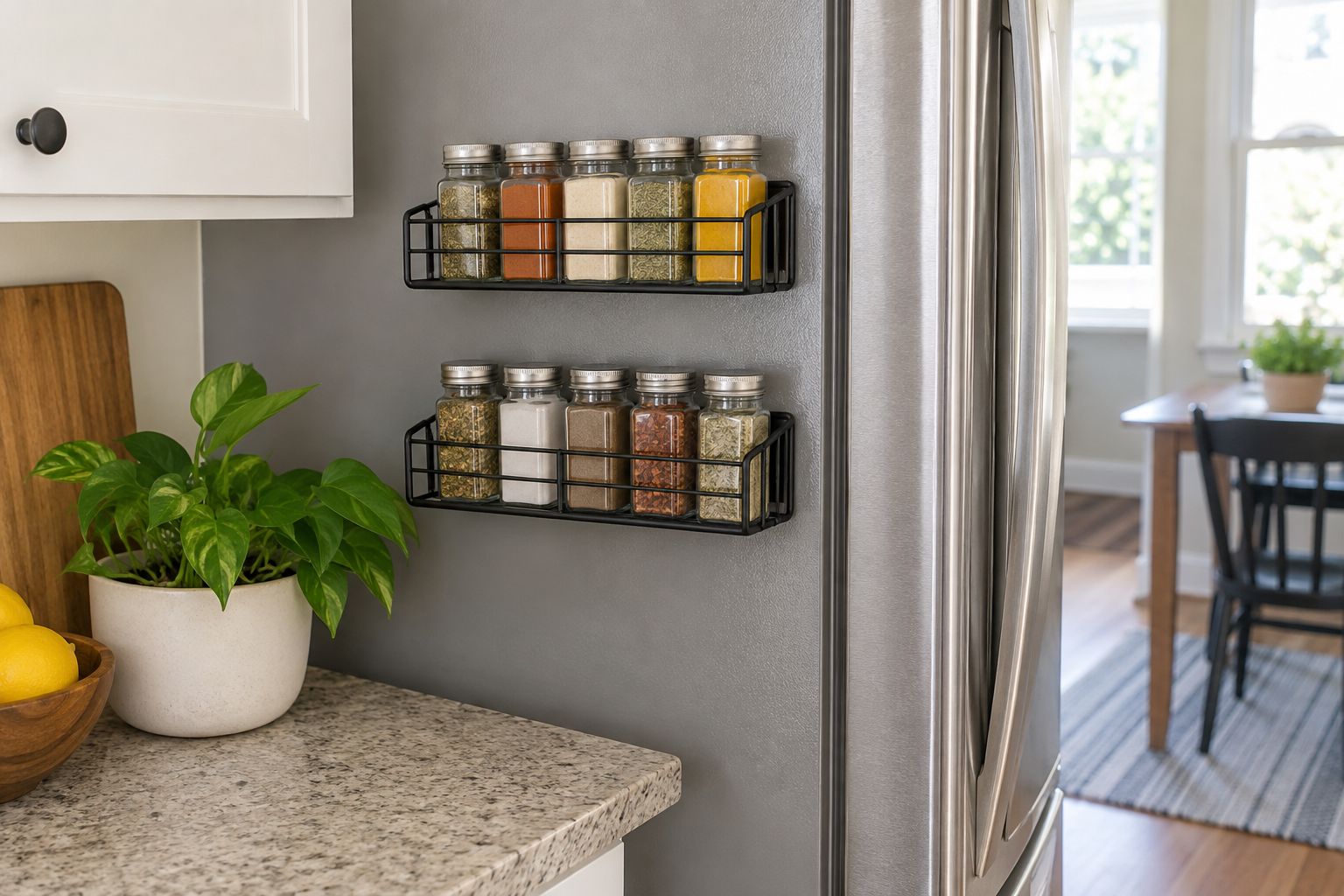
3. Use a Magnetic Spice Rack on the Side of the Refrigerator
A magnetic rack can turn an exposed refrigerator side into vertical spice storage without screws or adhesive. This can work well in a small kitchen where cabinet shelves are already full.
First test the exact refrigerator surface with a magnet. Some appliance panels are not strongly magnetic. Follow the rack manufacturer’s load guidance and avoid locating glass jars where they could be knocked off during normal kitchen movement.
4. Hang a Narrow Rack Over a Pantry Door
A narrow over-the-door rack can keep spice jars visible while using space that might otherwise remain empty. It is most practical on a pantry or utility door that has enough top clearance and room behind it.
Check hook thickness, loaded depth, and door swing before filling the rack. Our guide to over-the-door kitchen storage for renters explains how to measure these clearances before buying.
5. Use a Turntable for Spices in a Deep Cabinet
A compact turntable can make jars easier to reach in a deep cabinet because you rotate the tray instead of reaching behind the front row.
Choose a diameter that leaves enough room for the tray to rotate without scraping the cabinet sides. Turntables work best when jars are reasonably similar in height and are not packed so tightly that they fall against one another.
6. Try an Under-Shelf Spice Basket
Some organizers slide over an existing cabinet shelf and create a shallow storage layer underneath it. This can use otherwise empty vertical space without drilling.
Measure both the shelf thickness and the space below it. Make sure the basket does not block the items stored underneath or place too much leverage on a thin shelf.
7. Use a Removable Adhesive Spice Rack Only on a Suitable Surface
A removable adhesive rack can create useful vertical storage on certain smooth surfaces, but it requires more caution than a freestanding or magnetic option. Paint condition, surface texture, moisture, grease, and the combined weight of the rack and jars all affect performance.
Check the mounting-product instructions, test an inconspicuous area when appropriate, and avoid placing an adhesive rack directly above a cooking surface or somewhere falling glass could cause injury.
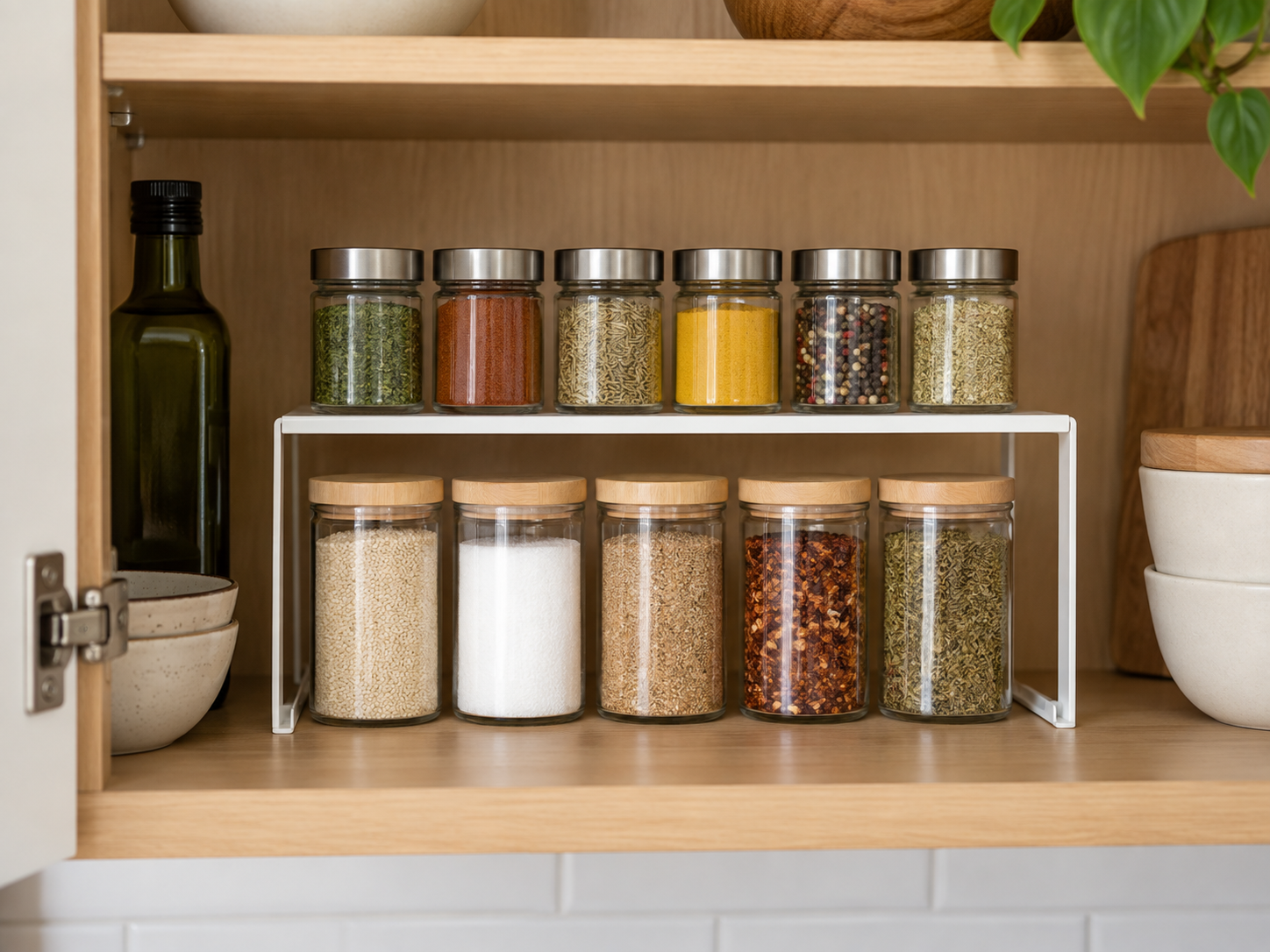
8. Use a Cabinet Shelf Riser for Two-Level Spice Storage
A freestanding shelf riser creates an upper and lower level inside a cabinet. Unlike a fixed shelf, it can be removed when you move and may work with other pantry items as well as spices.
Use the top level for jars you can identify easily and the lower level for taller containers or less frequently used seasonings. Avoid stacking jars where labels become hidden or retrieval requires moving several other containers.
9. Keep Everyday Spices in a Small Countertop Rack
If cabinet space is limited, a compact countertop rack can keep frequently used spices accessible without modifying the rental at all.
Placement matters. Penn State Extension advises storing spices and herbs in airtight containers in dry places away from sunlight and heat, and notes that storage above a stove can reduce quality more quickly. Keep a countertop rack away from the cooktop, direct sun, and areas exposed to steam. Penn State Extension provides additional storage guidance.
10. Use a Portable Spice Caddy
A handled caddy can be useful when there is no good permanent spice-storage zone. Store it inside a cabinet or pantry, then move it to the counter while cooking.
This approach is flexible and renter-friendly because the caddy is not attached to anything. It can also make moving easier because the spices are already grouped together.
Which No-Drill Spice Storage Option Fits Your Kitchen?
| Storage Option | Best Location | Surface Contact | Main Fit Check |
|---|---|---|---|
| Tiered spice shelf | Cabinet | None | Shelf depth and vertical clearance |
| Drawer insert | Drawer | None | Drawer height and jar diameter |
| Magnetic rack | Refrigerator side | Magnetic | Magnet strength and load rating |
| Over-door rack | Pantry or utility door | Door hooks | Top gap and loaded depth |
| Turntable | Cabinet or pantry shelf | None | Tray diameter and rotation clearance |
| Under-shelf basket | Cabinet shelf | Shelf clips | Shelf thickness and lower clearance |
| Removable adhesive rack | Suitable smooth surface | Adhesive | Surface condition and rated load |
| Shelf riser | Cabinet | None | Width and vertical clearance |
Where Should You Avoid Storing Spices?
A convenient location is not always a good storage environment. Try to keep spice jars away from:
- the area directly above or beside a hot stove
- direct sunlight
- steam from kettles, sinks, or dishwashers
- very humid cabinet zones
- unstable shelves or doors that shake during normal use
The goal is to combine accessibility with a cool, dry, stable location. A rack that looks efficient but exposes jars to heat or moisture can be a poor trade-off.
Common Mistakes With No-Drill Spice Racks
- Buying before measuring the jars: Container sizes vary more than many organizers suggest.
- Choosing adhesive first: A freestanding or magnetic solution may solve the same problem with less surface risk.
- Ignoring total weight: Several glass spice jars can become heavy when grouped together.
- Placing spices beside heat: Convenience near the stove can reduce storage quality.
- Hiding labels: A rack is less useful if you need to lift several jars to find the correct one.
- Blocking a cabinet or door: Always test the organizer with the door fully opened and closed.
- Assuming every refrigerator is magnetic: Test the intended surface before ordering a magnetic organizer.
How to Choose a No-Drill Spice Rack Step by Step
- Count the spices you use regularly and separate everyday jars from occasional ones.
- Choose the most practical storage zone: cabinet, drawer, refrigerator side, pantry door, shelf, or counter.
- Measure the available width, depth, and height.
- Measure your tallest and widest spice containers.
- Prefer non-adhesive options first when they meet the same need.
- Check the organizer’s size, mounting method, and stated load limits.
- Test cabinet doors, pantry doors, drawers, or refrigerator clearance before fully loading the organizer.
- Arrange jars so labels remain visible and frequently used spices are easiest to reach.
If you are improving the whole kitchen rather than just the spice area, start with our main guide to kitchen storage without drilling. For unused door space, see over-the-door kitchen storage for renters, and for the cabinet below the sink, see our under-sink kitchen storage guide.
Frequently Asked Questions
What is the best no-drill spice rack for renters?
The best choice depends on the space you already have. Freestanding tiered shelves, drawer inserts, turntables, and magnetic refrigerator racks are especially renter-friendly because they can often be removed without touching a finished wall or cabinet surface.
Do magnetic spice racks work on every refrigerator?
No. Some refrigerator panels have weak magnetic attraction or nonmagnetic exterior materials. Test the exact location with a magnet and check the organizer’s instructions before loading it.
Can I use an adhesive spice rack in a rental?
Possibly, but the surface condition, paint, finish, moisture, weight, lease terms, and adhesive manufacturer’s instructions all matter. If a non-adhesive option works equally well, it usually involves less risk to the rental surface.
Is it okay to keep spices next to the stove?
A location beside or above a hot stove is convenient but not ideal for maintaining spice quality. A cooler, dry location away from direct heat, steam, and sunlight is generally better.
How can I organize spices in a very small kitchen?
Use the space you already have more efficiently. A drawer insert, narrow tiered cabinet shelf, refrigerator-side magnetic rack, small turntable, or over-door organizer can add visibility without requiring a larger cabinet or permanent installation.
Final Thoughts
No-drill spice rack ideas are most useful when they match the actual kitchen rather than forcing every jar into one type of organizer. Renters have several options that require no permanent installation at all, including drawers, freestanding shelves, turntables, magnetic racks, and portable caddies.
Measure the jars and storage area first, keep spices away from excessive heat and moisture, and choose the least permanent mounting method that meets your needs.
A good spice-storage setup should make jars easier to see and reach without damaging the rental or creating a new clearance problem inside a cabinet, drawer, or doorway.